UTMB Training Plan 2027 – 16 Weeks to Chamonix

Mark Green
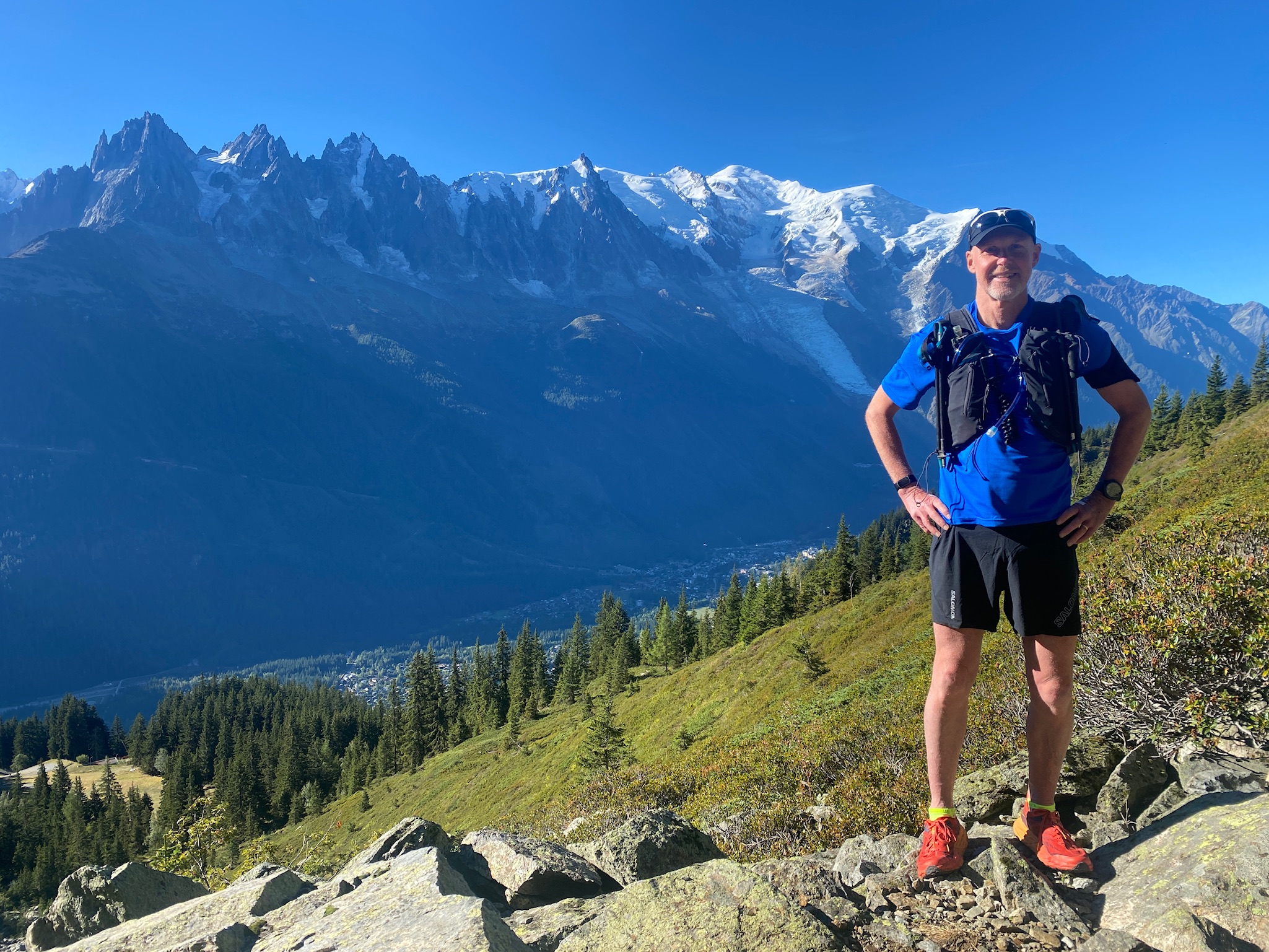
UTMB is about 175km and nearly 10,000m of climbing around Mont Blanc, through France, Italy and Switzerland. Most runners are out for two nights. It is the most famous trail race in the world, and one of the hardest to finish well.
This 16-week plan is built specifically for it. I have written it for runners who want to reach Chamonix in one piece, whether your goal is to finish or to race.
Written by a physio who works with runners
I am Mark Green. I have been a physiotherapist for 30 years, and I have spent most of that time treating runners and helping them run without injury.
I have not run UTMB myself, but I have coached a lot of runners who have run UTMB and CCC. This plan is built on what they told me afterwards: what went well, what went wrong, and what they wish they had trained for. Most of them said the same two things: the downhills were harder than the climbs, and they went out too fast on the first night.
Most training plans focus on getting you fit enough. This one focuses just as much on getting you to the start line uninjured, and on preparing your body for what UTMB actually does to it.
Why UTMB is different
UTMB has nearly 10,000m of descent as well as 10,000m of climbing, and the damage to your quads builds up over two days. The hardest descents come on the second night, after more than 140km. Most runners who struggle at UTMB do not run out of fitness. Their quads give out, or they paid too high a price for a fast first night.
That is why this plan builds your downhill strength from Week 1 to race day, and why it includes three back-to-back weekends to teach you how to pace the first night.
What is included
- 16 weeks of training at three levels: Beginner, Intermediate and Advanced. You have access to all three and can move between them at any time.
- Every run set out for you, with distance, vert targets, effort level and time caps.
- Three back-to-back weekends to practise pacing and running on tired legs.
- Strength, stability, stretching and rolling routines, with videos, that progress through the plan.
- Weekly technique coaching: uphill, downhill, hiking, poles, cadence and night running.
- A weekly nutrition guide, building up to your race day fuelling plan for 30-45 hours.
- Gear advice, including the UTMB mandatory kit, shoes, poles, headtorches and your drop bag.
- UTMB-specific race preparation: the course, altitude, heat, sleep deprivation, crew points, pacing and race week.
Choose your level
Your level depends on your running history and the time you have to train. It is not a goal time. Some runners finish UTMB in under 30 hours on the Intermediate plan, and others take more than 35 hours on the Advanced plan.
Beginner
For runners who have been training consistently for at least 2 years and regularly run 20-25km on hilly trails. Aiming to finish.
Week 1: 50km | Biggest week: 76km | Longest run: 40km | 4 runs per week
About 7.5-10 hours of running a week at the peak, plus 1-2 hours of body maintenance.
Intermediate
For runners who have been training consistently for at least 3 years and regularly run 25-30km on hilly trails. Aiming to run a steady race.
Week 1: 62km | Biggest week: 96km | Longest run: 45km | 5 runs per week
About 9.5-13 hours of running a week at the peak, plus 1-2 hours of body maintenance.
Advanced
For runners who have been training consistently for 4-5 years, regularly run 30-35km on hilly trails, and have completed at least one 100km trail race. Aiming to race the whole way.
Week 1: 75km | Biggest week: 108km | Longest run: 50km | 5 runs per week
About 11-14.5 hours of running a week at the peak, plus 1-2 hours of body maintenance.
Running times are based on 6-8 minutes per km. All levels include an optional cross training session each week.
How the training works
Back-to-back weekends
In Weeks 9, 11 and 13, your long run moves to Saturday, and you back it up with a 2-3 hour easy run or hike on Sunday. These weekends teach you to keep moving on tired legs, but mostly they teach you pacing. If you cannot run or hike comfortably on the Sunday, you went too hard on the Saturday. Most runners go out too fast on the first night of UTMB. These weekends are where you learn not to.
Vert targets by level
Every run has a vert target. The plan builds to about 400m of climbing per 10km for Beginner, 500m for Intermediate and 600m for Advanced. Every metre you climb in training, you also descend, so the vert trains your quads for the descents as much as your legs for the climbs.
Long runs capped at 6 hours
No long run in the plan goes beyond 6 hours. That can feel short for a race that takes most people 30-45 hours, but beyond 6 hours the recovery cost outweighs the benefit. Most runners do too much training rather than too little, and start the race already tired. Read why the long runs are capped.
Hiking and poles
Most runners hike the big climbs at UTMB, including many at the front. The plan trains you to hike efficiently and to use poles on both the climbs and the descents.
Two nights on the course
UTMB starts on Friday evening, so most runners spend two nights on the course. The plan prepares you to run on technical trails in the dark, and to manage the sleep deprivation of the second night.
No big mountains nearby?
You do not need to live near mountains to follow this plan. It includes stair sessions, treadmill sessions and strength work to build your climbing and descending strength wherever you live.
From runners who have done it
Read about UTMB and CCC from Streek runners who have been there:
- Peter Scott – UTMB
- Shane O’Neill – UTMB 2024
- Kim Loane – UTMB 2023: what it is like to hallucinate during an ultra
- UTMB and CCC training with Kim Loane
- Frank van Haren – CCC 2026
Frequently asked questions
When should I start the plan?
The plan is 16 weeks long, so start 16 weeks before race day. For a late August race, that is early May.
How do I know which level to choose?
Choose based on your running history first, then the time you have available. If you have been running 45-50km a week for the past few months, start with Beginner. You can change levels at any stage.
Do I have to do the back-to-back weekends?
No. If you do not have the time, or your body is already struggling with the volume, you can keep to the usual Sunday long run. But they are one of the most useful parts of the plan, so do them if you can.
Do I need to have run 100km before?
For the Advanced level, yes. For Beginner and Intermediate, you need a solid base of regular 20-30km long runs on hilly trails. If you do not have that, 16 weeks is not enough to prepare safely for UTMB, and CCC (101km) would be a better target.
I live somewhere flat. Can I still follow it?
Yes. The plan includes stair repeats, treadmill sessions and strength work for runners without access to big hills.
Should I use poles?
Most runners at UTMB do, and the plan teaches you how to use them. If you start the race with poles, you must carry them the whole way, so you need to train with them.
Does the plan cover the mandatory kit?
Yes. The plan explains the UTMB mandatory kit and gets you training with a full pack well before race day.
Ready to start?
UTMB is a race most people only get one shot at. Give yourself the best chance of reaching Chamonix strong.