Race Report – CCC 2026 – Frank van Haren

Mark Green
Background
I’ll start with a bit of background, just to put my experience into perspective. I did the race 3 weeks before turning 58. I came relatively late to endurance sports but have always been very active. As a Dutchman, I of course played soccer when I was young and after that did a variety of sports. My first half marathon was in 2008 at the age of 40, my first (and only) marathon was in 2010 in New York (a story for another day, such a great experience!). Then I did some long-distance cycling events, Ironman 70.3 (twice) and I ran my first ultra trail event (with virtually no training, what could possibly go wrong?) in 2013, the North Face Challenge 50 km (which is now the UTA). Between 2013 and 2018 I ran 9 ultra distance races including three 100 km events: UTA, Tarawera and the Alpine Challenge in the Victorian Alps. Unfortunately, old soccer injuries caught up with me, and I had meniscus problems in both knees, and surgery on one of them. I had also developed a Morton’s neuroma (foot injury) for which I also required an operation. I figured my ultra trail running days were over, especially because every time I tried to ramp up running mileage, my knees would hurt, keeping me awake at night, so I sort of gave up. I never completely stopped running but only ran shorter distances (home-work-home) and never did any speedwork.
Then in 2022 I decided to run one more Kosci (the shorter 27 km distance), essentially as a goodbye to trail running events. However, this run went so unexpectedly well that I was wondering whether I would be able to get back into it. I successfully completed the Tarwera 50 km in 2024 and then found Mark Green, who has this amazing combination of being an elite runner, a physiotherapist and a coach. He examined my knees, analysed my running technique, and after some convincing accepted to support and coach me, hopefully back into longer events. Without going too much on a tangent here, the secrets to success included a change in running technique that involved shorter stride length and higher cadence (mine was 160 steps per minute and over time I managed to get this to 175/min, never quite to 180), to reduce the stress on my knees. Other very important elements were a big focus on strength training, stretching and foam rolling, and training sessions mostly done in heart rate zone 2 to reduce the risk of injury and the stress to the body.
In 2025 after some good months of training under Mark’s guidance, I celebrated my “comeback” by doing the Tarawera 100 km. I managed to finish in 16 hours, which was 2 hours faster than when I did this before my injury. And my knees felt fine! So then came Kosci 100 and UTA 100. The 2 main big challenges I was hoping to step up to, now that my injuries seemed under control but also noting I was fast approaching 60, were the UTMB and “a miler”. I wasn’t going to make UTMB my first miler (and boy am I glad I didn’t!), so I put my hat and stones in the ring for the UTMB CCC – and got in!
Preparation for the event
There is so much to talk about when describing the preparation for an event like this, but I am not writing a book on ultra trail running – there are many good ones out there! So, I’ll just touch on the three main things that helped me a lot.
- Structured and consistent training by following my coach’s weekly plan. Mark did a marvellous job working around my busy life that involves a lot of international conference travel and long shifts at the hospital. I did roughly 5-6 runs per week including one long run and some very careful and controlled speed work, 1-2 sessions on the bike, 2-3 strength sessions (mainly Les Mills body pump classes at the local gym), and everyday there would be the Streek stretch or foam rolling sessions. I think the total training time added up to 10-15 hours per week, which was manageable despite my demanding job.
- Nutrition. One of the best things I did was get in touch with Tamara Madden, nutritionist (madonnutrition.com.au). During my first consultation with her (this was before my Kosci 100 in 2025), it became clear to me that I had been doing most things completely wrong when it comes to nutrition, hydration and electrolytes. I learned a lot from her, and she then designed a personalised race nutrition plan for me for Kosci, again for UTA and then for the UTMB CCC. I have followed her advice religiously and I can’t overstate how much of a difference it has made for my events.
- Recovery. Coach made it very clear that one of the secrets to effective training is good recovery, which includes getting enough sleep and not overdoing training (again the Z2 runs). This was not always easy with my work and also my travel (often resulting in jetlag), but I definitely tried to pay a lot of attention to recovery.
Chamonix before the event
My friend Sean, who had signed up for the UTMB miler, and I arrived on the Monday evening, with CCC starting Friday morning. With the extra days we were hoping to get over the jetlag and perhaps acclimatise a little bit to the climate and altitude. Coach put some easy 20-minute taper runs in the diary for each day up to Friday, to keep the legs ticking over.
The vibe and tribe in Chamonix were absolutely amazing. So many runners, all looking super fit, with chiselled bodies, I felt I had no right to be there amongst that crowd! I was wearing a Kosci ultra shirt and was noticed a few times by fellow countrymen who then called “Aussie Aussie Aussie” – and you know the rest. People were connecting, they were all there for the same reasons and it was a wonderful experience to just be part of that.
The organisation was (and I am sorry to say this) quite clunky, with relatively poor communication. I quote another Australian UTMB CCC runner who posted this on her Strava: “Ironman’s decision to punish Australian and New Zealand runners with a compulsory carbon contribution on top of an expensive race entry was poorly planned, communicated and executed, with a complete absence of how the money was going to be spent. Forcing those who travel the furthest to pay the most stinks”. Despite the nice-looking event website, the runner’s guide and all other materials, some essential things were incredibly hard to find out. Was there a mandatory gear check (which most other races have before the event)? We couldn’t find this anywhere, so decided to bring everything to the bib pick up, but it turned out nothing was ever checked. Another issue was the lack of information about where the bus was going to depart from, to transport the runners from Chamonix to the start line in Courmayeur. No address was provided and I nearly went to the wrong place. Fortunately, I did a reconnaissance the day before the race with my running mate Sean and we found out that we both had been completely wrong regarding the bus departure point, and we managed to find the right spot. Just imagine that would have happened on race day….
Race day
So, I got on the bus and arrived in Courmayeur 90 minutes before my start group would head off (wave 3, half an hour after the elites). The weather forecast was horrible, with weather warnings for severe rain and severe wind, as well as thunderstorms. This turned out to be correct and most of the day, the weather was foul, which definitely made the race much harder. The actual start was memorable, with Vangelis’ Chariots of Fire playing loudly – the Italians know how to throw a start party!
After some kilometres we hit a bottleneck at the start of the first big climb, and we had to wait for almost 15 minutes before slowly starting to move up in single file up to Tete de la Tronche. Some people tried to jump the cue by going around the waiting crowd and they were immediately booed loudly and crowd shamed, so they quickly stopped their antisocial behaviour, which was actually incredibly funny. This first climb was long, very steep, slow and really hard. Little did I know then that every climb after this first one was also going to be long and ultra-steep…
I felt strong and ran everything that was runnable but had to accept that most of the course was not runnable for mere mortals like me. I struggled a bit with the altitude, which made everything harder. I developed a headache which I though could have been because of the altitude (I’ve suffered from altitude sickness before but usually only at much greater altitudes, between 3500 and 6000 meters). I took some paracetamol after which the headache mostly disappeared.
As mentioned, the ascents were very steep and hard, it is unlike anything we have in Australia. People were really struggling going uphill and started dropping out left right and centre especially later in the race, it was carnage. The weather was not helping… The only thing harder than the ascents were the descents. I am normally reasonably confident going downhill, albeit not super-fast. I am always conscious that going downhill very fast is high risk and low yield, and a tiny mistake can mean injury and DNF, so I always try to be as controlled as possible. The descents of this particular event are hard to describe, the word that comes to mind is brutal. The descents were more technical than anything I had ever experienced, steeper, longer, and just so very difficult. Tree roots, rocks, and just steep. The heavy rain made many parts muddy and slippery and there was no way I could go fast. Some parts I barely managed to walk down the steep challenging bits. Because I could not take advantage of gravity on the downhills and had to constantly put the brakes on, my quadriceps told me to find another hobby around the 85-90 km mark and refused to let me go downhill faster than snail pace after that. Somehow my knees held up though!
Despite all that, I went really well and hit Champex-Lac (aid station at 54 km and the only one that allowed a drop bag) after 11 hours, so I thought I was well on target to finishing in 22 hours which had been my goal. What I didn’t know then (again, poor communication by the organisers), was that they had changed the entire course because of the weather, which meant a longer run (108 km instead of 101) and also more vertical meters (6500 instead of 6200)… But more about that later.
Just a few words on my nutrition strategy, which was close to perfect. I had no moments where I “bonked”, to use the correct technical term, and no moments of nausea or sickness, and no cramps. With nutritionist Tamara, I had made the (difficult) decision to be mostly self-sufficient and not rely on the food items provided at the aid stations. The main product used at UTMB are Naak drink, gels, waffles and bars, and I didn’t have a great experience with those when I tried them out in the weeks before the event. So, I decided to use what worked well for me in the past, even though it meant I would be carrying a lot of extra weight during the entire event, because there was only one drop bag allowed, and I did not have the luxury of a support crew. My strategy involved roughly 70 grams of carbohydrates per hour by using a mix of Tailwind, jam sandwiches, bars, gels, chews and bananas, as well as 800-1000 ml of total fluid per hour and one electrolyte capsule every hour. Yes, I carried a lot of stuff including a 1 ½ litre bladder for water that had to be refilled at every aid station, but this was all worth it for me.
Another thing to mention is that I did not keep track of distance, time, or pace. I found that in the past, having Garmin stating, “x kilometres done”, reminding me how many kilometres I still had to go to the finish, could be quite daunting and almost demotivating. Nowadays I only have an alarm set at every 60 minutes, to remind me to take my electrolyte capsule and to keep track of my calorie intake. I managed to FaceTime my wife back home during a flattish ascent, which was great. She asked me if I knew how many kilometres I was already in and I said I didn’t know and didn’t want to know. I was happy to just keep going. The Livetrail app provided by UTMB was fantastic. Friends and family both in Australia and in my home country the Netherlands were all following me and could track my progress in detail. I received many encouraging messages via WhatsApp during the race and the support of my wife, kids, mother, brothers, family and friends meant the world to me.
During the race, I tried to connect with some of the fellow runners and had some very nice interactions and met some great new people. However, generally, most runners did not seem interested in talking. Asking another runner, “How are you going?” was often met with a short “good” – end of conversation. To quote a Strava post from a female Aussie runner who did the same event: “Not all competitors were friendly, but perhaps that’s European racing? I certainly felt like a small fish in a big pond…” I think it could also have been the language barrier, with many runners perhaps not able to understand and speak the English language. Certainly, the volunteers including at the aid stations on this course were amazing and very friendly.
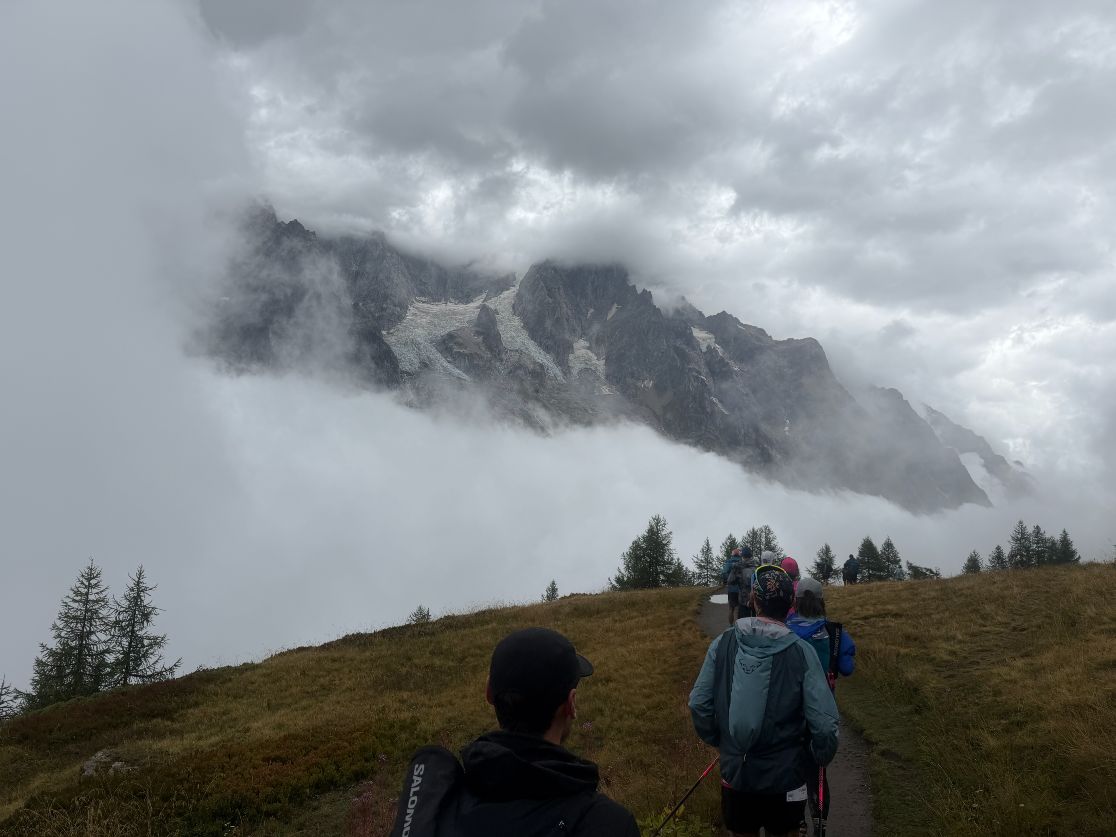
The scenery was utterly mind-blowing. To run through the Italian-Swiss-French alps, see the sunrise over the snow-covered peaks, catch glimpses of the Mont Blanc (Europe’s highest mountain), run through forests, alpine landscapes, picturesque villages, all this was just such a privilege to see and experience.
As mentioned, I felt strong and I continued to pass lots of other runners, but after about 85-90 km I started to struggle. There were 3 things that happened.
First, my feet and especially my toes started hurting. I had decided to use Creepers socks (instead of my usual Injinji), which are kind of a thick wool toe sock that I found to be very comfortable for the long runs. It is hard to explain what happened, but after 80+ km the wool started to become “felted” (perhaps because of the rain, the constant movement friction and the long duration). Essentially, the wool became rock hard and really started hurting my toes. I regretted not having changed my shoes and socks at Champex-Lac where I had another pair of shoes and fresh socks in my drop bag – but at that time everything had still felt fine.
The second thing that started bothering me was chafing in unpleasant places. This has always been a challenge for me, despite trialling numerous running shorts and brands, and various products. I think the rain, sweat and long day out were simply too much, despite very liberal and repeated application of Aussie butt cream…
Finally, my quads started protesting, probably because I had to constantly hit the brakes on the long, steep, technical descents.
Taken together, this made the remainder of the race very hard and very slow… A second dose of paracetamol was tried but did not have a great effect this time.
When we were close to Chamonix and actually could see it, we were sent up a big hill again for no obvious reason. On the map it looks small, but it was steep and hard going. I spoke with an English runner who was furious “they are doing this to us”… That last bit went on forever and we all felt we were aimlessly wandering up and down that mountain. Because I had not received notification or information of the course changes, I had no idea how much longer I had to go. Other runners also didn’t know but mentioned hearing rumours that an extra 7-8 kilometres had been added. I expected one more aid station but that one was removed after the course change. Fortunately, I was carrying enough fluids and calories to sustain me to the finish. Someone told me we had already done more than 100 km, and we were clearly not anywhere near the finish. I felt low, sore, cranky and demotivated and just wanted this to be over…
But then, thankfully, it became a beautiful sunny morning and lots of people were out for a walk or a run on that mountain. What gave me a big boost was the support and words of encouragement from almost every person I encountered, not just the volunteers. This was truly something else and so heartwarming: Allez allez allez, courage, looking good Frank, good job, almost there, go Frank. The locals were clearly proud of their race(s) and the non-locals were probably all there because of the event (either to do one of the races or to support someone). I have never before felt so supported and encouraged during an event. This became even more amazing once I finally hit Chamonix, and the course became runnable again, going alongside the river and over the road, the last couple of kms to the finish. There were people everywhere and although I was just another runner, not elite, just middle of the pack, people were cheering me on, calling out my name, telling me I was amazing, go Frank!!! This really brought tears to my eyes, and I struggled to keep it together emotionally…
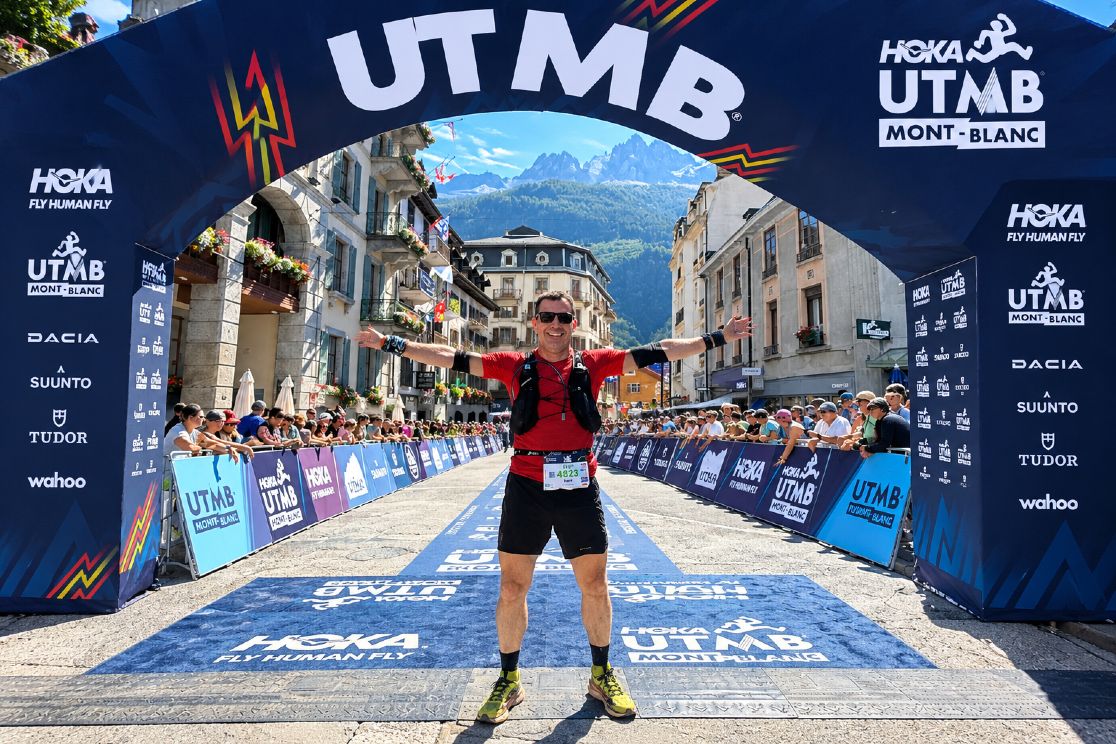
And finally, there it was. The finish felt like I had won the race, so overwhelming was the reception, the crowd was cheering!! I could hear my name everywhere and I felt incredible and so grateful…
Afterword and reflections
Perhaps one of the most amazing elements of this event was that everyone supported and cheered for everyone, fast or slow, during every race! What a vibe and what a community!!
The next day I checked the race results and found out there had been a huge number of participants who had not finished. There were 458 DNFs out of 1974 starters, nearly 1 in 4! The official number of entrants was 2230, so 256 entrants never even made it to the start. The large proportion of DNF surprised me, I would have thought that this event would bring together the best runners from around the world, with the best preparation. I guess it was a very hard race, partly because of the foul weather, but mostly because of the challenging terrain and the altitude, the very long and steep ascents and technical descents. And I find it incredible that the elite runners can actually run down those treacherous descents…
When thinking about the course, I would not really know how one can truly prepare for that when you live in Australia. There is really nothing that I have experienced down under that comes even close (and I’ve done UTA, Kosci, Tarewera and lots of other runs). I found the Alpine challenge hard and steep when I did this many years ago, but even that one does not compare to the UTMB CCC course and terrain.
Reflecting on the experience, this was a once in a lifetime thing (I’m not doing that one ever again!). It was hard (but to quote coach Mark, we wouldn’t be doing these things if they weren’t hard), amazing, special and humbling. I feel so privileged to have been able to do this despite my age and injuries.
So, onto the next adventure. I still have a miler to do before turning 60…. And now I know what to expect, should I attempt the full UTMB in a few years?
Mark, when does my training start?
Thanks for reading and feel free to reach out if you have any questions.
Frank van Haren