Race Report – Sydney Marathon 2026 – Kawai Leung

Mark Green
I’ll say this upfront — I rarely blog or journal but a few things made me want to write about this race:
- This race meant something special. This race was my first-ever Abbott World Major Marathon, right here in my own home city. I blew up during my first marathon two years ago and have not run a marathon since, so I have been training and anticipating this second chance for a while. I imagine by my third or fourth marathon, it would feel a lot less exciting and challenging, so I wanted to capture this moment whilst it still felt big.
- It hasn’t all been smooth sailing. Frequent injuries have thrown this journey up and down, and often made me question whether running was for me. I wrote this story to hopefully inspire others but also as a reminder to myself: if you get injured again (touch wood) to stay positive, it’s happened before and you can get through it again.
- A lot of friends/family/colleagues/ex-colleagues have been following this journey for the longest time. I figured they deserved a little more this time.
The backstory
The injuries prior to Sydney Marathon’24 :(((
When I told my physio/running coach Mark that I wanted to write this race blog, he said if I wanted to tell the story properly, I’d need to rewind to two years ago when I started training for my first marathon: Sydney Marathon 2024.
For the two years leading up to that race, my running had been on and off. Not because of a lack of discipline or commitment but because I kept getting injured. I’d plan a 16-week training block, and almost without fail, my ankle or knee would get injured along the way. Each setback took a toll. It was tough missing out on morning endorphins, but even worse was feeling like my PBs were slipping away and there was nothing I could do to grasp it. This was a tough and frustrating lesson. Running wasn’t like other pursuits, where more effort led to better results. Instead, running had its own ruthless logic: doing too much too soon guaranteed injury.
Sydney Marathon in 2024 was… yikesss
A couple of weeks before the Sydney Marathon 2024 I sustained a knee injury which forced me into an early taper. At the time, it was questionable whether or not I’d even make it to the start line but by some miracle I did.
However, whenever I reflect on this race, the words that always come up are “tragic,” “crash and burn,” “lived a slow and long painful death.” Honestly… due to my injury-induced inconsistent training and poor race day execution, it really was – a crash and burn experience with a slowww and longggg painful death 😰.
Going into your first marathon, you read a lot about hitting “the wall” (aka bonking), but you don’t truly understand it until it happens to you. For non-runners: hitting the wall means your body completely depletes its glycogen stores and is forced to burn fat for fuel—a much slower, far less efficient energy source. For me, this struck brutally early at the ~28th km at Centennial Park – what felt like a never-ending 3.5km loop. My legs felt like solid cement. My pace sharply dropped to a near-walking pace. My mental cognition had gone too. Somehow I had lost all my gels before the last ~12km and found myself in a delusional state, miscalculating the distance remaining.
Disastrous as it was, I made it to the finish line. It wasn’t the time I wanted, but I was proud of my accomplishment — my first marathon completed.
It’s funny – when I crossed the finish line, I remember distinctly saying “I’m never doing this sh*t again”. Fast forward only two days later, I had agreed with my friends that I’d do it again. I guess the physical pain faded a lot faster than the sense of accomplishment, and the blow up made me feel like I had unfinished business. At the time, my friends called the next marathon the “Redemption Race”.
Two years in the making
Built from broken
Unfortunately, coming off the back of Sydney Marathon ’24, my knee injury got worse and I could barely walk pain-free, let alone run. An MRI revealed I had a bone bruise on the back of my kneecap. At that point, I had nearly given up hope and genuinely believed it was a “career-ending” injury for me.
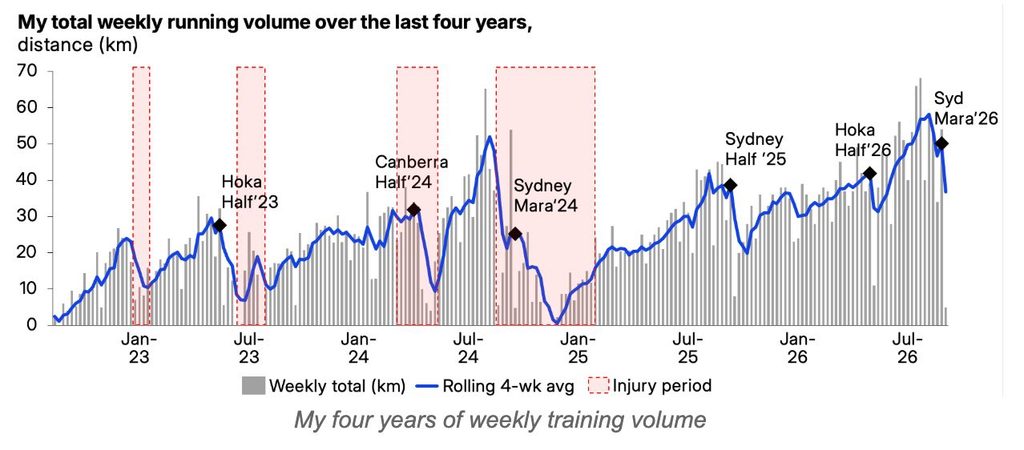
As one last line of hope, I had heard a lot of good things about Mark (my current physio / running coach) and decided to see him. The rest was history. I ended up seeing Mark monthly for the next two years. The road to recovery was slow and a test of patience but two years later, I had stitched together 90+ weeks of consistent running. If you told me two years ago this would happen, I wouldn’t have believed you.
So what changed? In short, my training chased consistency over intensity. Instead of “going hard or going home everyday”, my running ethos changed to become “running so that I can run more the next day”. Practically, this meant:
- Slowwwwwly ramping up my training load – By slow, I mean real slow. At the beginning, my total weekly mileage barely increased by 1-2km each week. Additionally, Mark told me to stop all speed workouts for the time being because my injury risk was too high. I was initially reluctant as I was eager to improve and everything out there told me speed workouts would make me faster — but Mark convinced me: my path to a PB was consistency, not intensity. I did not have the foundations to handle speed work yet and the belief that “running slow makes you slow” was a myth.
To my disbelief, after less than a year of consistent training with no speed workouts I ran a -8min PB at the Olympic Park Sydney Half. 🥳 Ironically, because of these results, when Mark re-introduced speed work back into my training plan several months ago my first reaction was “do I have to??”
- Taking easy runs truly easy — For all easy runs, Mark told me to keep my heart rate within my zone 2 range. This was another thing I was reluctant about because it meant being a slave to my heart rate monitor and it made running feel slow, boring and meaningless since I couldn’t exceed a 7:30min/km pace at the beginning. I thought about giving up and ignoring this advice many times but Mark said “those who don’t stick this out almost always end up injured and they always end up back where they started needing to restart the process”. Looking back, I’m glad the younger me was sensible enough to listen because nowadays, I believe zone 2 training is the best thing that has happened to my running. Every run now feels like a walk in the park – it barely makes a dent on my body. I can even talk on the phone whilst running. And the best part is, it’s true – you do gradually get faster at the same low heart rate! As they all say, you just have to trust the process.
- Distributing mileage across more days of running — Instead of concentrating all my mileage into 3 days, we distributed it across five. The idea was to run less each day, over more days, rather than more each day over fewer. Since this let my long runs shrink to only ~40% of my weekly mileage (instead of dominating it), I was a lot less “wiped out” afterward. Previously, I’d not only feel severe DOMS but need 3-4 hour naps after every long run just to recover. Now, so long as I get a decent meal in, I’m proud to say I’m a fully functioning human being after every long run.
All-in-all, all these changes did make me feel like a “lazier” / “low-effort” runner but it worked. It allowed me to string together weeks and weeks of consistent training and by the time I was ready for Sydney Marathon 2026, I had not only stitched together two years worth of running but a peak weekly mileage of ~70km with speed work included.
Daring to dream. Daring to achieve.
Throughout the training block, there was one question I continued to ask Mark and all the AI engines I threw my data at (ChatGPT, Gemini, Claude): is a sub-4 marathon possible?
I had completed my long runs (~32km) at an easy pace of 6:00min/km so I knew that if I just held onto that pace for another 10km, it was well within my ability to achieve a 4:10 marathon time. But I wanted to push a little further — I wanted to run a sub 4:00 marathon. This meant running at a 5:40min/km pace, 20s per km faster than my long run pace. I did think this was slightly ambitious considering my half marathon PB pace was only at 5:27min/km but the craziness in me wanted to go for it.
The AIs gave me a 60% chance of achieving a sub-4. Mark thought I could do it, but he asked me: “Would you rather go for a goal you know you can achieve, or one you don’t know you can get risking a blow up?”. The thing with running endurance races is if you shoot too ambitiously, you don’t just risk missing your goal but you also risk blowing up completely and missing what you were actually capable of. Chasing a 4:00 meant potentially finishing at 4:30+ and also having a miserable race like I did the first time.
Despite the risks, my response to Mark was simple: I’d rather die trying.
Something in me wanted to shoot for the stars. Going into the race, I knew I was going to suffer. I knew there was a real chance I’d blow up and have another tragic race but these were outcomes I was willing to own in an attempt to see what I could achieve.
Race day: a day of no regrets
First half
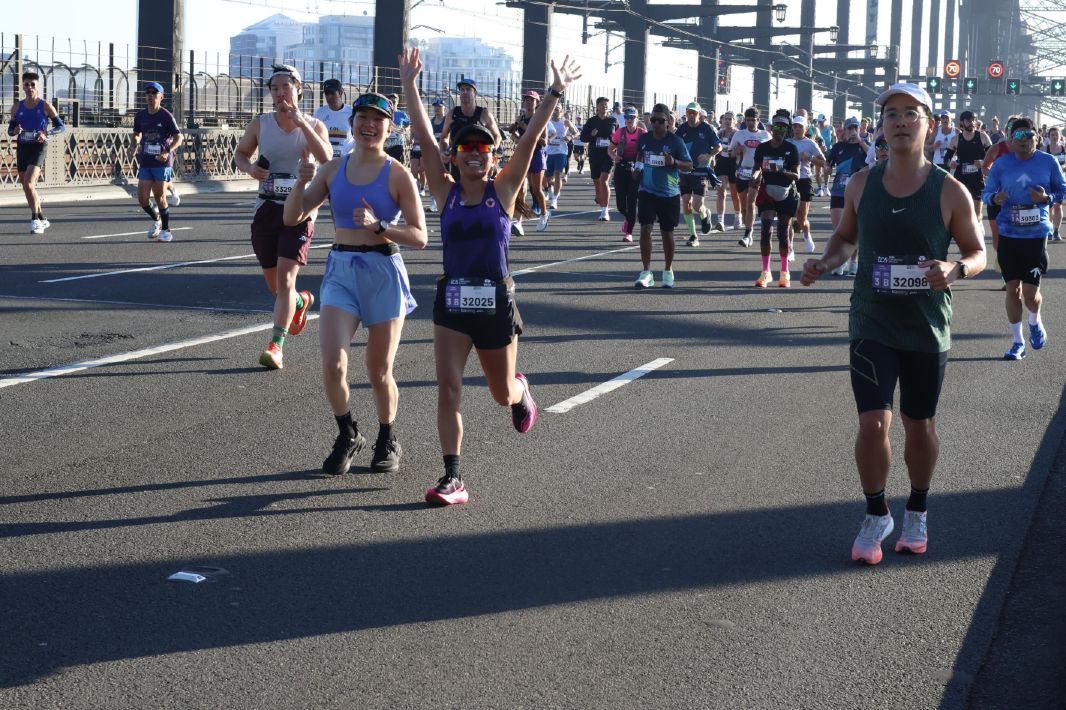
The first half of the marathon went by really quickly. I started off strong, completing the first half in 1:59:44 — right on target for a sub-4 marathon. I was lucky enough to have my friend, Sue, pace me through the marathon so she kept me running at the right pace.
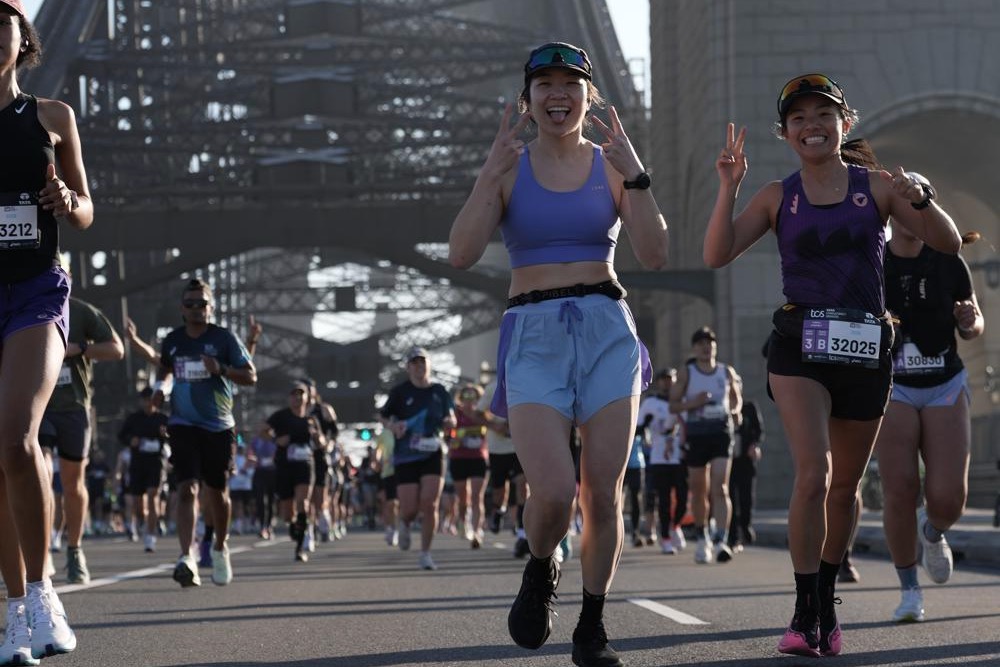
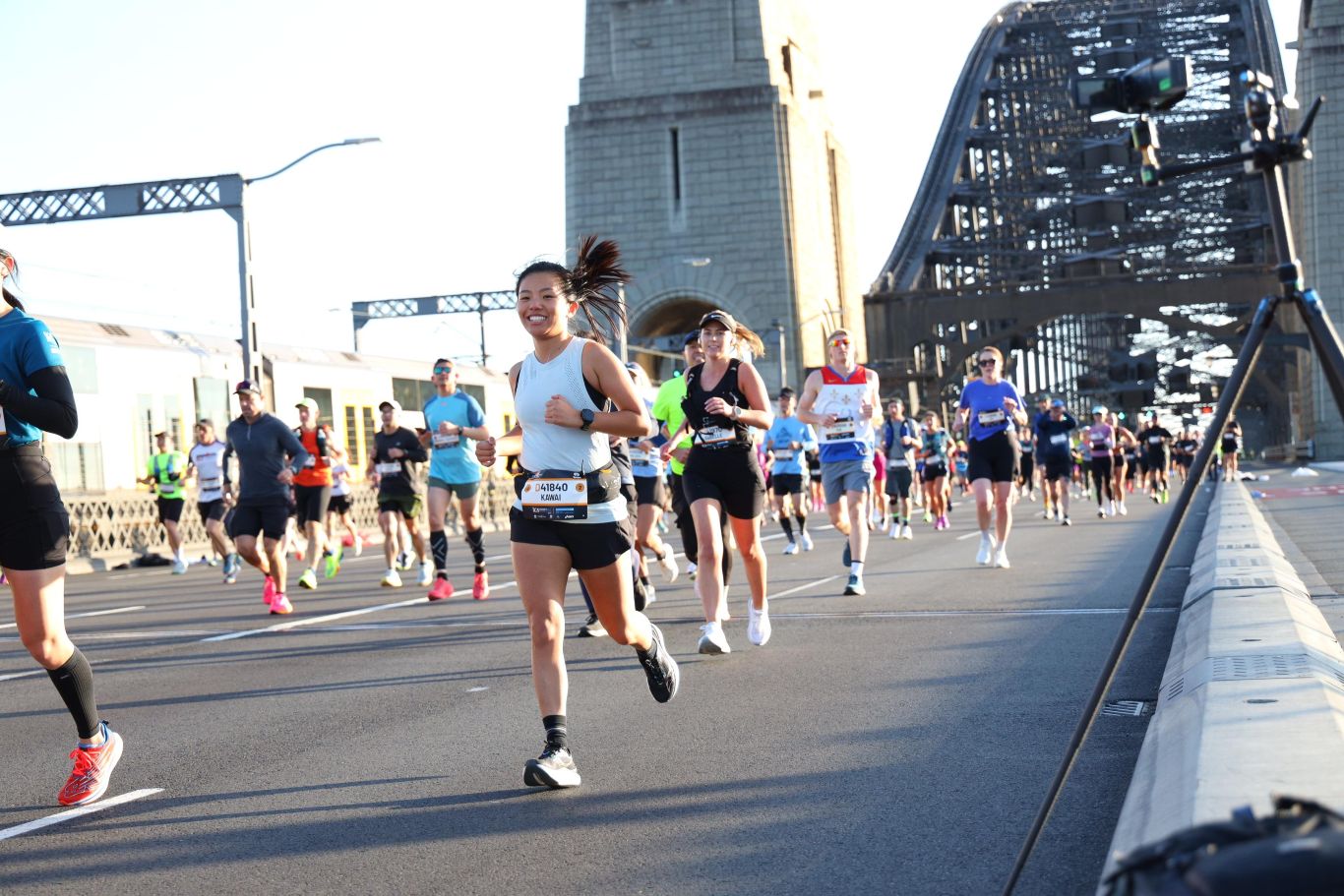
The course started with a net 5km downhill over the Sydney Harbour Bridge so I focused on increasing my cadence and letting my legs roll down the hill to not ruin my quads. As we approached a steep downhill before the Sydney Harbour Bridge, Sue said “this course really doesn’t set people up for success hey” – it really did not. Running across the bridge was definitely something to savour. It was a nice sunny morning so the structure lit up orange in colour.
At the Pyrmont 5km water station, I called out to my friend, James, who had volunteered to hand out water. He yelled out fist in the air “pain is temporary, PBs are forever”. I laughed and continued running.
After the 5km water stop, the real hills came. The course continuously went up and down into Pyrmont, Western Distributor highway, Pitt Street and Macquarie Street. It made pacing slightly difficult. I found myself losing breath but I shook it off as being because I was running uphill and that I’d catch it back on the flats/downhills.
At the 15km mark, after all the hills, I felt a slight tinge of exhaustion in my legs and I thought “it’s a little early to feel this way” but I told myself “Kawai believe, Kawai” and kept charging on.
As soon as we hit Anzac Parade, I locked in on my marathon pace. There were moments I sat on Sue’s tail to reduce my perceived effort and block some wind. At the 20km mark, I passed Runi, who was bubbling with the Golden Retriever energy I needed. I told her “I’m dying” as the fatigue hit my legs, and she screamed “No you’re not! You’re doing amazing! You can do this!! Woooo!”
Second half
I held my pace until ~25km, and then it all went downhill. My legs were flooding with fatigue, and the sub-4 pace group that had been with us most of the way had pulled well ahead. Sue said, “Let’s just aim to finish.” I didn’t have much choice but to agree.
On the backwards stretch of Anzac Parade, I really felt it. It had a slight uphill incline for 10km straight which made my quads give out. It didn’t help that the sun was blazing and there was barely any shade.
Then, right before entering Centennial Park (at 28km), I felt a shockwave through my right calf. I was beginning to cramp. I took a swig of Crampfix – a foul, vinegar-tasting fix that burns on the way down. It helped but my calf still felt one wrong step away from seizing up completely.
Running the Centennial Park loop was just as hard as it had been during my first marathon. My quads and calves hurt so much I couldn’t help but start walking — the first time I’d ever walked in a race. I wondered if I was being a wimp, not digging deep enough, but every step just hurt more than the last.
The brain fog started to kick in – possibly from the lack of glycogen or hydration, or both. I started catastrophizing and questioning my life choices (a marathon classic when you’re 30km in). Disappointment got the better of me and I pulled out my phone to text my high school friend group, who I knew were waiting to cheer me on at Hyde Park: “sorry guys this is tragic.” They responded with the most positive energy – “keep going” , “keep fighting”, “you got this”, “let’s go” – but I didn’t get the chance to read it until after the race.
I turned to Sue and started my 2-hour whine: “ughhhhhhhhh!!! How are we here two years later doing the same thing, suffering the same way, feeling the same pain! All this training – FOR WHAT?! I never want to do a marathon again!” (Of course, not true.) Sue stayed composed and let me have it: “Keep letting it out. Keep moving.” I kept going for a bit until I realised it wasn’t helping my situation. Turns out whinging doesn’t make a marathon any shorter.
My most memorable moment in Centennial Park was when a cheerful spectator saw me grimacing in pain and said “QUEEEEN YOU LOOK GREAT, PLEASE KEEP GOING” so I picked up the pace for 10 metres only to fall back to walking. Honestly, the crowd support that day was great – I was not.
When I left Centennial Park and had 8km left I launched into my own out-loud monologue “Shut it off Kawai, shut it off Kawai. Shut it off! It’s just 8km left. You do this nearly everyday as your easy run”. Sue kept feeding me encouragement and I continued to run and walk.
When I finally got to Hyde Park I was excited to see my high school friends cheering for me. It gave me a surge of energy to run the majority of the last 5km without walking even though Mrs Macquarie’s Chair was hilly.
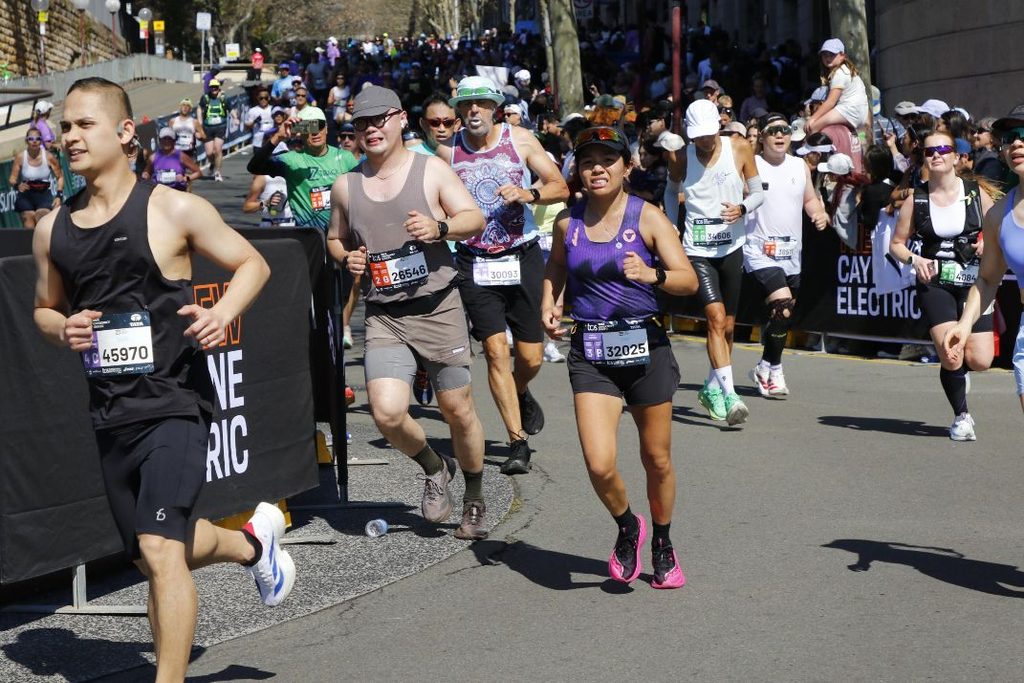
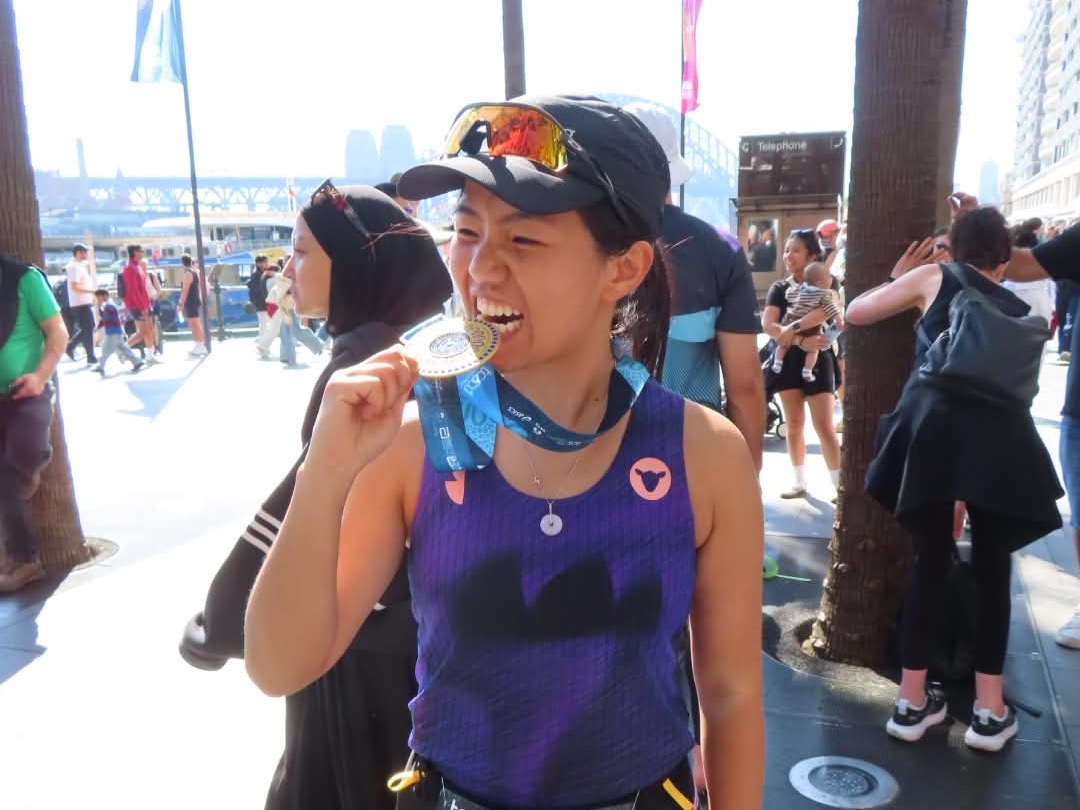
After Mrs Macquaries Chair, I picked up the pace knowing I had 2km to go. The Opera House forecourt was roaring with energy, everyone crowded around the finish line. The finish sloped downhill, and I just wanted it to be over so I ran faster. A few metres before the finish, my calf cramped again but I knew I was done. I crossed the finish line. Sue gave me the hug I’d asked for 3 hours into the race – then picked me up, literally lifting me off my feet, before my calf seized up hard enough that she had to put me back down. I held onto her to stay upright while volunteers checked I was okay. And then it sank in. It was done. I made it. I finished. My first World Major. My finish time was 4:45:09 – a 12 minute PB from my first marathon.
Final thoughts
Despite missing my 4hr time goal by a mile and feeling the sting of that, it was still a day of no regret. If I could go back, I wouldn’t change a thing. I know I could’ve had a better race if I had settled on aiming for sub-4:10 and started slower, but I made the deliberate decision to go for gold and test the limits of what I could achieve – a decision I don’t go back on. And now, knowing the outcome, I know what to do for my next race.
The sub-4 dream will come. Hopefully next time. Incoming Redemption Race 2.0.
“Appreciathon” 💗
To end on a more cheesy note, special shout outs to:
- Mark for helping me keep dreams alive and sharing age-old wisdom
- Sue for being there for me every step of the way through the race and putting up with my princess whining 👸🏻 on the day after her Hens
- Amy for being my long run training buddy – I’m sorry I dragged you into suffering through this with me
- My high school friends & Runi for coming out on course to cheer me on – You guys are the best! Thank you for giving me something to look forward to mid-suffering. Thank you for always making me feel like I’m never in things alone. Thank you for reminding me finishing a marathon is a big deal irrespective of the finish time.
- Jasmine & Eliza for sending me messages of support from Canada and Japan throughout the race – your energy was felt!
- The crowd support – From listening to the Glee Club Choir sing Eye of the Tiger at Pitt Street to hearing all the loud cheers, Sydney was ELECTRIC. I couldn’t have asked for more.