Race Report – Sydney Half Marathon 2026 – Jeremy Maitland

Mark Green
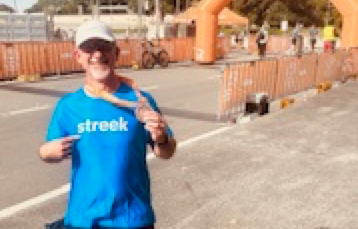
I have been Streeking for nearly two years now. Not the “get your kit off and run on a footy field” type of streak, but using the STREEK training program. This year I am being more serious about running and am into my third half marathon of the year. I ran the Sydney Half last year, and it had been the first event I’d run with crowds and thousands of other runners and that had taken some adjusting. When setting my running goals for 2026, I had a sense of what to expect and had set it up as a PB race. I had already beaten my PB in my first two half marathons, lowering my time from 1:57 to 1:51:17. My goal for Sydney was getting under 1:50.
I’m staying at a friend’s place in the lead-up to the race. I live an hour and a half from Sydney, so there is something enticing about not getting up at 3:00am to make the start line. Ben is a gun runner — not just for our age group, but by any measure. And while I say it half-jokingly, there’s a very real part of me that has made beating Ben one of my running goals. His PB sits about twenty minutes ahead of mine. You aim high, right? Ben is my benchmark, and I’ll chip away at his times until I stop running. He’s a reason to keep chasing my own PBs. I played a lot of competitive team sport when I was younger and miss that feeling of taking on an opponent. PBs aren’t quite the same, but they’ll have to do until that gap to Ben closes a little more.
During training, I’ve used a mantra to stop myself from overdoing it: “There is a day when the time matters, but that day is not today.” Today is it’s race day — finally, the time can matter! My pre-race routine is well established: one cup of oats, a cup of skim milk, a dessert spoon of dextrose, and a coffee. Gear laid out the night before.
I’m up at 3:30am like a kid on Christmas morning, but there are no parents to send me back to bed, so I get dressed. I can’t get my running singlet on. Have I put on excess weight overnight? Has Ben sabotaged my race by encouraging me to eat dessert at dinner? I’d pinned the front and back of the singlet together with my race bib. Weight crisis averted!
We’re on the 4:26am train, and the excitement builds as we get closer to the city, with more runners boarding at each stop. Why don’t I look tall, lean, athletic and young like they do? I remind myself that I am short, ate dessert the night before, and am in my mid-fifties — that’s why. Ben asks how I’m feeling. “Not as great as I’d hoped. I’ve been a bit sick this past week or so.” Ben mentions a sore foot that could affect his race. We remind each other that everyone seems to have a niggle or a minor illness in race week, and that it will be fine once we get going — like always.
I know that big race events mean big toilet queues. I’ll put it in the post-race survey that there should be an express lane for people who are truly busting! If you’re doing a large race, allow plenty of time before the start. The queues at the race village are actually much shorter than the ones right off the train — I’ll file that away for next time. Although the queue is long and time seems short, there’s a big difference between your start time and when you actually start, as the start chute is packed with thousands of runners and you can spend up to twenty minutes in there. This year, I felt relaxed about it.
I have a complicated history with race plans. In an act of self-sabotage at the Sydney Marathon last year, I arrived with a plan, stood on the start line, spotted a pacer, and decided on the spot to follow them instead. I finished well off both the pacer’s time and my own goal. In my first two races this year, I stuck to my plan diligently. The plan is simple: set the goal time, then run the second half five seconds per kilometre faster than the first.
That simplicity gives me time to stress-test the splits and mentally lock them in before race day. This time, I had rough numbers in my head but didn’t truly settle on a plan until the night before. The night before I think the pace looked too quick for the time I wanted, so I toyed with splitting the race into three progressively faster segments instead. In the end I stuck with the usual plan, but not feeling fully settled on it had an impact on the day.
Two PBs had me feeling confident in the lead-up, so I expected Sydney to play out like the others I’d run this year. I’d mentally bookmarked Mrs Macquarie’s Chair as the climb to brace for near the end. I had been cooked by this stage so that incline had stayed with me. That feeling from last year made me forget about the other undulations scattered throughout the course. The hillier nature of the course caught me off guard, the total elevation was nearly double that of my two previous races, and I felt it through the back half.
I followed the STREEK training program in the lead-up and it gave me a solid base overall. I had been troubled with a sore hamstring on and off, so I saw my physio, who I’ve known for years. She told me I “you have a weak arse” — physio speak for weak glutes. Her words reminded me that I’d skipped too much of the strength and conditioning work in the program. Who would have thought its just as important as the running!
Race day conditions were considerably warmer than what I’m used to training in, but I had made an effort to hydrate well over the previous 72 hours. I’m a big sweater — losing up to a kilogram on a 10km run — so I know hydration is key for me.
In the first few kilometres I’m running slightly above my target average for the first half, so I try to ease back to stay on track. With 28,000 participants and a tight course in some sections, finding a rhythm was hard.
I find that walking through drink stations works better for me than running through them, but in the first few stations I lost more time than I should have — a combination of congestion, station length, and not knowing where the electrolytes were. In my first two half marathons this year there were around 200 competitors, and the drink stations were very short, so walking through took about ten seconds. In Sydney, with so many more runners, they were much longer, and it was taking me fifteen to twenty seconds to move through each one. It wasn’t until the fourth station that I worked out the electrolytes were positioned at the far end, not the start. Had I known sooner, I could have run past the water and only slowed at the end for the electrolytes, rather than walking through the whole station every time. This is the day that time matters, so the seconds matter. It sounds obvious in reflection, but you have a plan and your mind can scramble in the thick of it.
At the halfway mark I was averaging 5:17 per kilometre — just two seconds per kilometre off my race plan pace. Close enough to feel encouraging, but those lost seconds at the drink stations were already in the gap and doing some damage. I thought congestion would ease by mid-race, but it was worse — more people were walking or slowing down, and my pace was becoming faster than slower. The elevation was ramping up, and with four kilometres to go I was falling behind my target pace. There were several steep undulations in the final kilometres; I wished they were the rolling hills from my training routes. I decide to give one last push and run kilometre 18 in 4:50, my fastest of the race, but I was gassed over the next three and fell back above plan pace. At this point I mentally changed plans accepting the PB was out of the question, but I was determined to at least beat last years’ time.
Mrs Macquarie’s Chair didn’t seem as bad this year and I moved up it with reasonable pace. A young woman beside me was being encouraged by her training partner to keep going. “You’re nearly there.” She replied, “I don’t think I can.” I chipped in: “Come on — I’m the age of your dad; you don’t want to be beaten by me.” She found a smile and replied that her dad was older than me! I don’t have time to work out if it’s a compliment or note. The three of us picked up the pace, and then in the last descent the two of them passed me and were cheered on by a group of sign-holding friends. Perhaps my motivational words made the difference — maybe I should be a motivational speaker. Or perhaps they just wanted to get away from me. I’ll go with the first scenario. I cross the line not as spent as last year but disappointed with the time. The time mattered today and it wasn’t the one I wanted. I’ll have to wait another year to go under 1:50 in Sydney.
My key race takeaways from Sydney are more strength and conditioning, sort out the drink stations, and check the course elevation more closely beforehand.
I started running later in life, so I am impatient for improvement and feel that time is against me. I check the results — the fastest in my age group finished 49th overall in 1:19:17. There’s not time to get there. There’s plenty of time for another PB and there might just be enough time left to beat Ben.