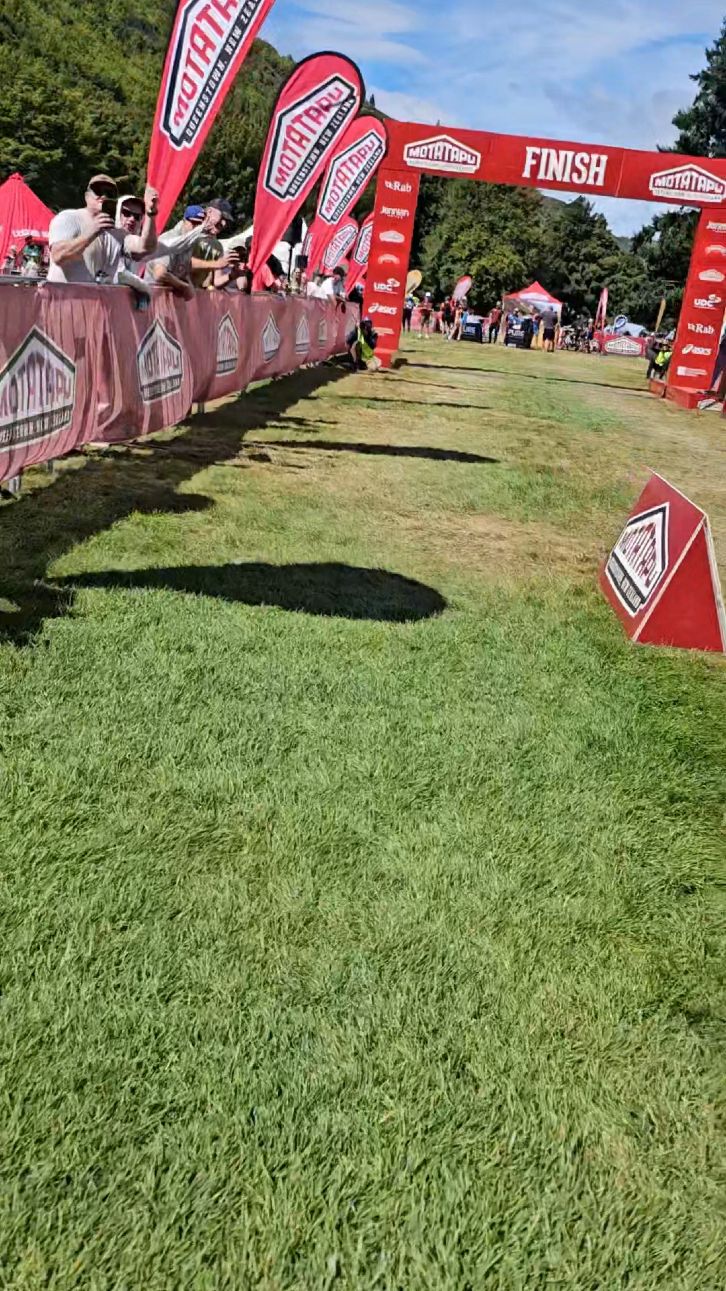
Race Report – Motatapu 50k 2026 – Mark Green

Mark Green
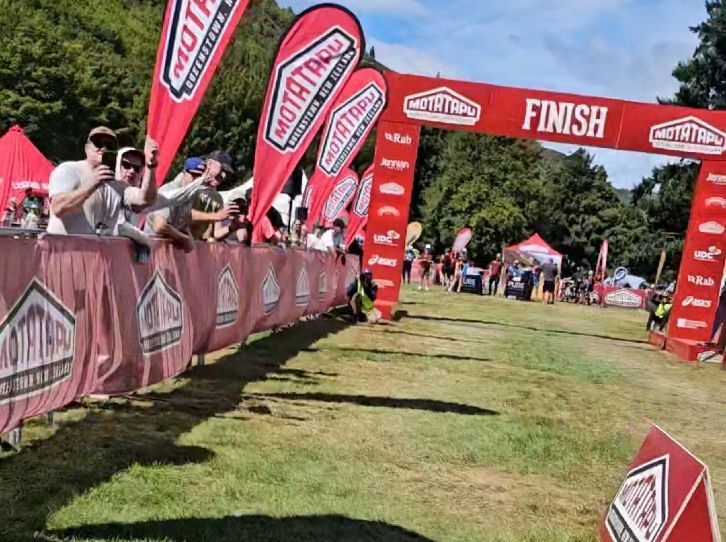
Motatapu 2026 – Race Report
After turning 50 in 2023 and realising my days of competitive racing were probably behind me, I decided it was time to start doing some different events rather than repeating the same ones every year.
There are races I love – UTA, 6 Foot Track, and more recently UTK – but I recover much slower now. I also genuinely enjoy long training blocks of short, easy runs, that keep you fit, but don’t take too many cookies out of the jar. So I have become fairly selective about what events I enter.
Last year I did the 45km Hounslow Classic and loved it.
For 2026 I chose the Motatapu — deep in the south of New Zealand, near where I grew up, but a race I’d never actually done.
Over the last 4–5 years my old Otago University flatmates have been trying to organise a reunion. A couple of half-planned gatherings never eventuated. One of them recently moved to Wanaka, so we locked in Motatapu weekend for a gathering and finally made it happen.
I ran the 50km Ultra.
My four flatmates entered the 15km Miners Trail Run.
None of them are runners, so this was probably going to be a bigger adventure for them than for me.
Or so I thought.
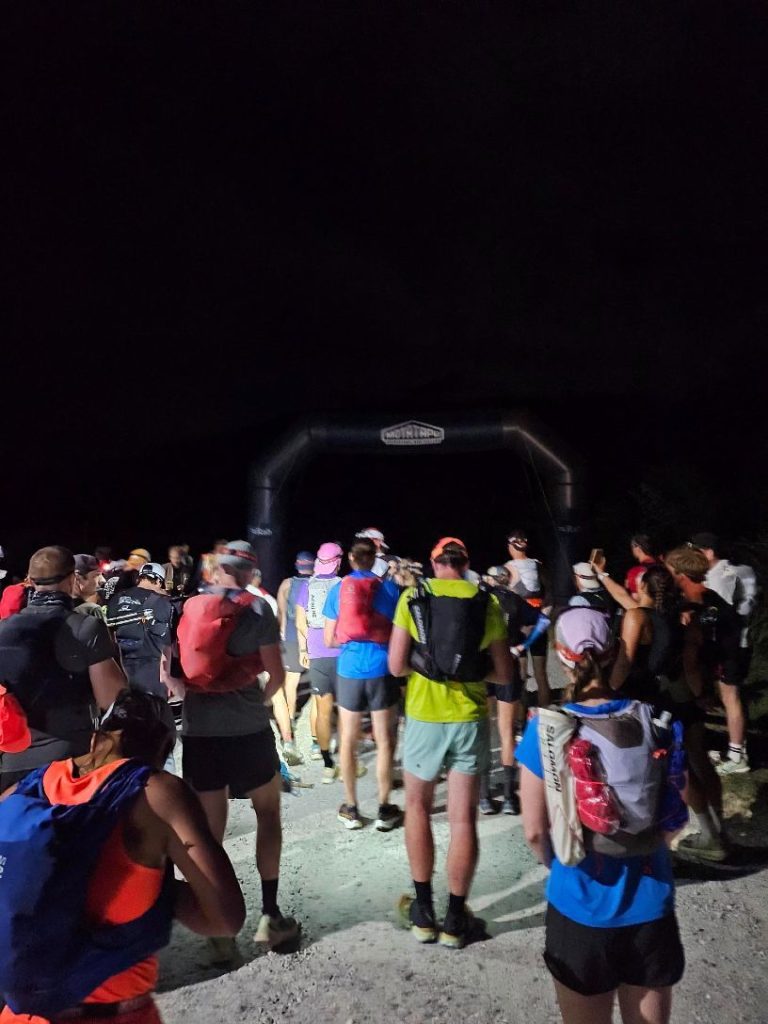
The race started at 6am in the dark on a surprisingly balmy Wanaka morning — about 18 degrees.
We ran up a gravel road for 3km before hitting single track and beginning a steady climb up the Fern Burn Valley through a dark, rooty forest toward the Fernburn Hut checkpoint at 9.5km.
We reached it in 1 hour 15 minutes, and it certainly didn’t feel like we’d been mucking around. The terrain was already slowing things down.
As we arrived, the sun was rising behind the mountains creating silhouettes around us. It looked spectacular.
It also made it very clear what lay ahead.
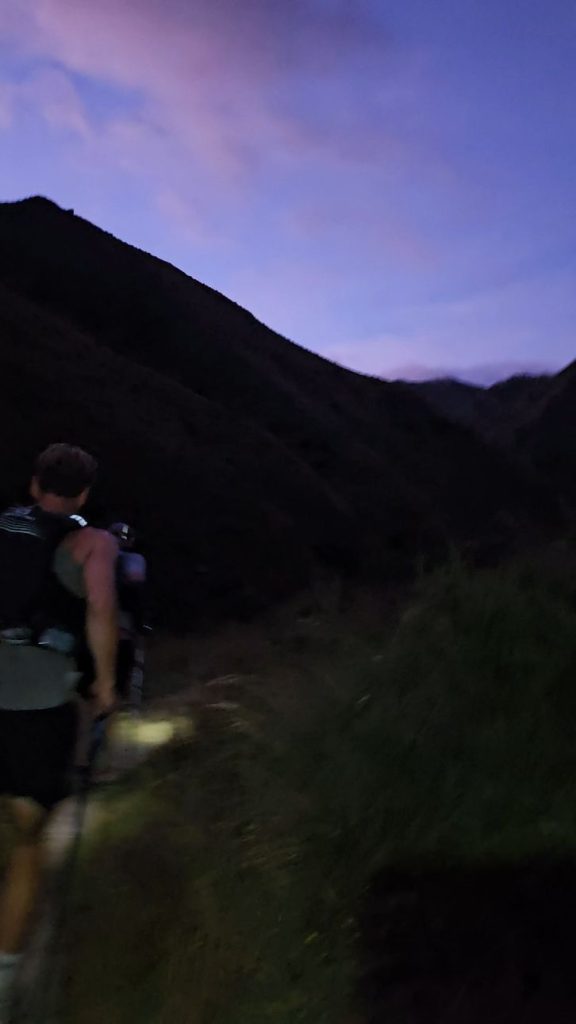
From Fernburn Hut we climbed a steep single track scramble up to Jack Halls Saddle, followed by what felt like an even steeper descent to Highland Hut (CP2) at 15.5km.
By this point we’d burned through 2 hours 20 minutes.
Surely now there’d be some runnable terrain?
No such luck.
From Highland Hut we went straight back up a brutally steep ridgeline. I could see 4–5 runners just ahead of me, but by the time I reached the top they had completely disappeared.
I’d forgotten my poles, so I was using my hands to pull myself up the tussock in places. A 12–13 minute kilometre felt like solid progress.
The descent off that ridgeline was just as steep and technical. I don’t know the official gradient, but 30% wouldn’t surprise me. Even now, four days later as I write this, my quads are not functional.
And it wasn’t just me struggling with the descents, a few young blokes I’d been running with were openly hating the downhills as well.
After that descent?
Another steep climb.
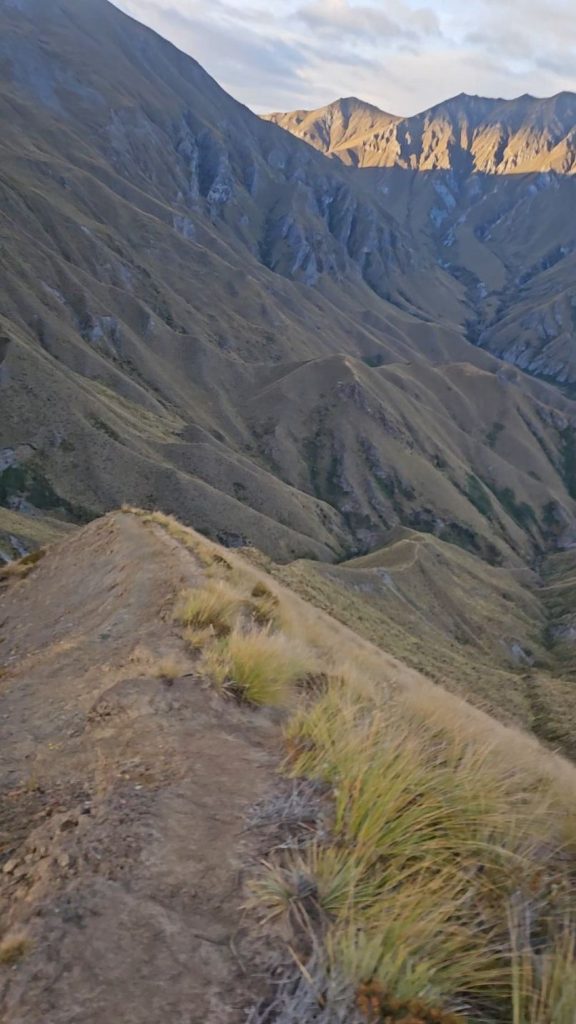
Up to this point there had been a few small clusters of runners moving together. I’d been chatting to whoever was nearby — asking where they were from, whether they’d done Motatapu before, what other races they’d done.
This was partly curiosity, and partly a distraction from the terrain.
At one stage I was running with a guy who’d grown up in the Blue Mountains and was now a GP in Te Anau. I told him I’d grown up in Te Anau and was now a physio in the Blue Mountains.
Small world.
I guess if you grow up somewhere outdoorsy, there’s a reasonable chance you end up gravitating back to it in some form.
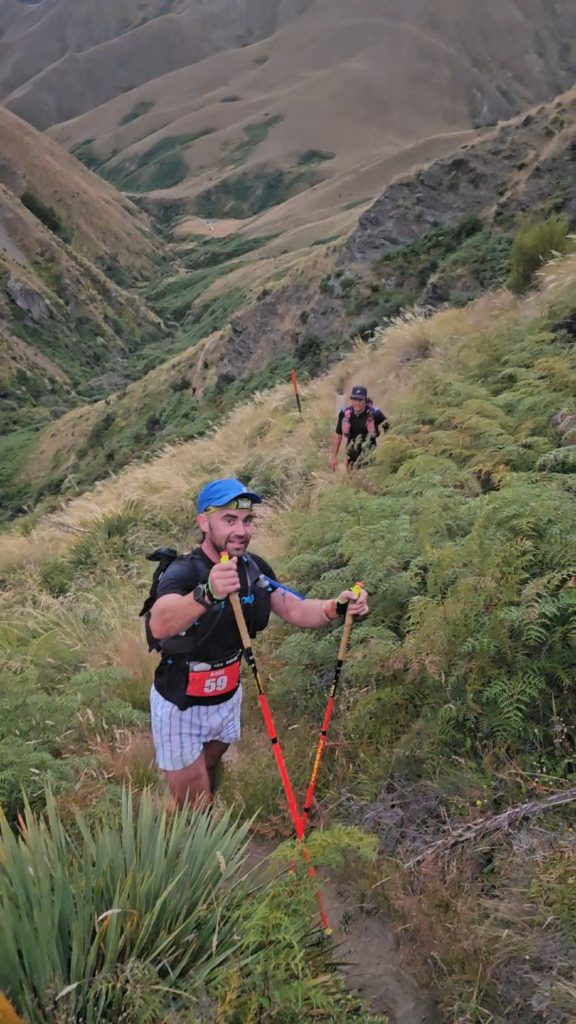
At about 22km we hit what I think was the steepest section of the course.
Two runners were right behind me.
Without turning around I asked one where he was from.
“Sunshine Coast.”
“What races have you done?”
“Glasshouse, Noosa… and Kepler.”
He sounded young, so I said, “I probably ran the Kepler before you were born. When were you born?”
“2002.”
I ran the Kepler in 1988!
The bloke behind him said, “I was born in 2003… so you’re older than both of us put together.”
Awesome. Thanks mate.
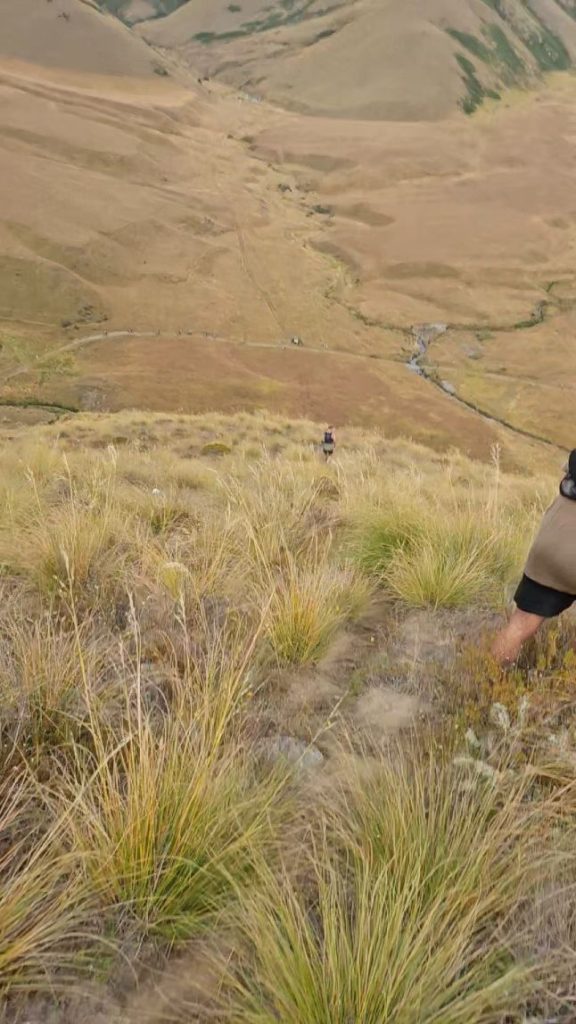
At 25km we crossed paths with the MTB race, which runs on the same day. For a brief moment it looked very appealing to be riding to the finish rather than grovelling over another ridgeline.
At 26.5km I reached Roses Hut, restocked on gels, coke and electrolyte drink, and headed up the final major climb to Roses Saddle.
From there we dropped onto a narrow, semi-tussock covered single track heading toward the river. We’d been told we’d be taking the low water course this year.
I assumed that meant a nice trail following the creek.
It did not.
It was essentially a 4km river descent.
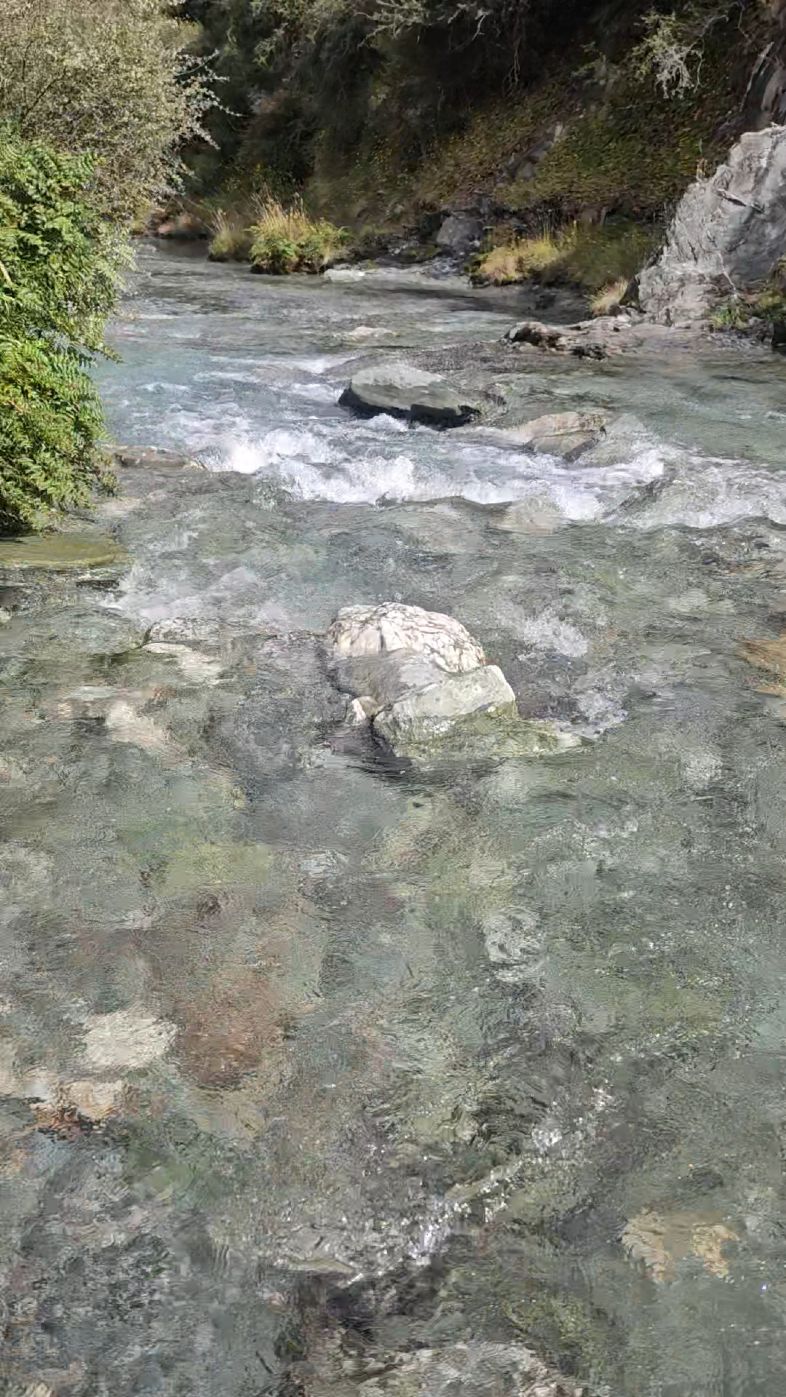
Short sections of narrow trail would appear for 30–40 metres, then vanish, forcing you back into knee-to-thigh deep water over a very rocky riverbed.
It felt exactly like running the river section of the Coast to Coast race in the 1990s.
In retrospect, it was unique and pretty amazing.
At the time, I was cracking the shits about how slow I was going and wondering if any part of this course was actually designed for running.
At 36.5km I finally reached Macetown (CP4) and was told it was 16km of 4WD track all the way to Arrowtown.
Finally, something runnable. It felt good to be able to stretch the legs out a bit.
I was moving along this section well, still eating gels regularly and drinking both electrolytes and Coke. My energy levels were stable.
Until 46km.
That’s when the wheels started wobbling.
My calves began cramping and my running form became more of a shuffle. This didn’t feel like a carbohydrate issue. It felt like lack of specific training finally catching up with me.
I went into this race as undercooked as I’ve ever been.
A dodgy knee since Hounslow (after a couple of solid falls) meant my downhill training had been limited. I managed two decent downhill sessions in the three weeks leading in — which probably saved me from complete destruction — but the legs were clearly not fully prepared for 3000m of descending.
I shuffled into Arrowtown in 7 hours 50 minutes.
I’m fairly sure that’s my slowest 50km ever.
Which says more about the course than the clock.
The climbs were relentless, the descents savage, and the single track technical almost the entire way.
I finished 17th overall and somehow managed a 1st place in the geriatrics division.
I’m also 100% confident I couldn’t have gone any faster on the day, which is always a very satisfying feeling regardless of placing.
My nutrition was on point for the whole day.
- 20 Pure Sports Nutrition gels.
- 2 litres of Coke.
- 1.5 litres of Pure electrolyte drink.
- 1 litre water
- no vomits!
For the second race in a row I had managed the nutrition well.
If you’re looking for something genuinely hard and a bit different, I can highly recommend the Motatapu Ultra.
And if you want to bring friends or support crew, there’s a 47km MTB, a 42km trail marathon (with 1,000m vert), a 15km run with 800m vert, and a 4km kids’ event.
Something for everyone.
Just maybe pack your poles.