Race Report – Merapoh 55k Ultra Trail 2026 – Alasdair George

Mark Green
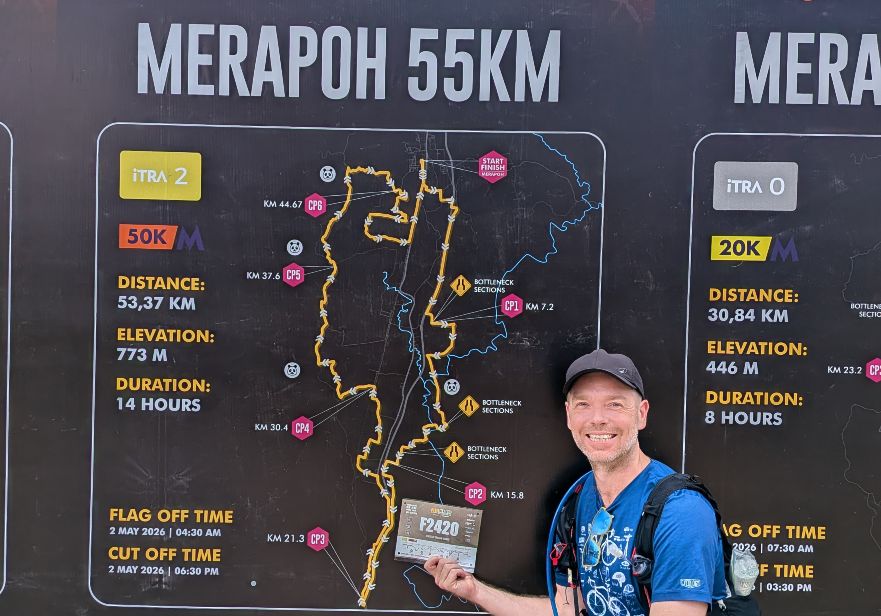
Rainforest, Palm Oil Plantations, Rivers, Karsts, Caves and did I mention Rivers?
Why and Where
I had just completed the Streek 12 week Base Training Plan at the beginner level when I discovered the spanner in my plan to register for the UTMB TransJeju 100km in October.
TransJeju required both an active UTMB index and either a 50 or 100km category ranking within the last 36 months.
Not only had my index deactivated as I hadn’t done a UTMB event in 2 years, my 100km category ranking was also outdated as my last (to date only) 100km had been 39 months ago in the Kosciusko100.
Fortunately the organisers of the Merapoh Rainforest Trail accepted me as a last minute registration, and the race would fulfil all the Jeju qualifying criteria.
The race kicks off in Kampung Merapuh Lama, population 870, on the border of the Malaysian states of Pahang and Kelantan. A region full of dramatic limestone Karsts, waterfalls and caves and gazetted as The Lipis National Geopark, Malaysia’s largest national geopark.
In the race’s 5 editions it has grown to be one of Malaysia’s favourite international trail events with 2,200 competitors in 2026 and events ranging from 10km to a Miler. Part of the attraction being the relatively mild elevation change of the courses and the multiple caves traversed.
The Race
Race kick off was 0430 in the dark on what, in hindsight, were forebodingly warm conditions. It was probably 24 degrees and as I realised later about 92%+ relative humidity. So not cool at all despite having been dark since 7p.m. the previous day.
The first 7.2km to CP1 were a mix of road, gravel and 4×4 track run through the lens of a hyperspace effect caused by our headtorches and the mountain mist in the air.

By then I was drenched with sweat despite deliberately running significantly below my usual zone 2 pace. This triggered a conscious change in upping my consumption rate of electrolytes that continued throughout the race.
It was also at this point that we started to meet 100km competitors who had started 11 hrs earlier and were now joining our trail for their final 50km.
Immediately after CP1, there was a short single file climb up a rockscramble to our first cave.
The roof was at least 5* my height with a vaulted roof and strategically placed race photographers.
Once we passed through the cave it was onto winding single track and gravel roads through rainforest and palm plantations until the ~12km mark where the first river was met.
This was a short ~100m wade through a cathedral of overarching trees meeting above the broad river lit up by our head torches and the reflections off the water. It started with a thigh deep dip followed by ankle deep splashing before exiting onto slick clay banks.
From there the single track and gravel roads continued into the equivalent of forest fire trail and the steepest climb of the run while the first rays of dawn appeared. The climb was steep enough to begin feeling it in the calves so I alternated some backwards walking and sidestepping to stop the calves from blowing up early in the race.
Fortunately the race only had 773m of elevation to play with so the climb wasn’t more than 10 minutes.
Not long after cresting the summit, the sun rose and upon finishing the descent we entered the second cave of the course.
This cave, Gua Hantu Menari, had a stream running through the middle that you could avoid by crouching down and scrambling along the side for 30m before realising that you couldn’t avoid it afterall and once again embrace warm wet feet.
Soon after CP2 (15.8km) came into view.
A quick restock of iced water and my electrolyte sachets, a banana and watermelon then on we go.
Sidenote:
All the CP were stocked with lots of fresh fruit, banana bread, pandan bread and multiple drink options including 100Plus, water, iced water etc.
CP3 had fried chicken, noodles, rice and more solid food.
CP5 even filled my running bladder with ice. Very much appreciated.
CP2 to CP3 was a 6km slog along a slightly uphill tarmac road as the sun progressed through early morning.
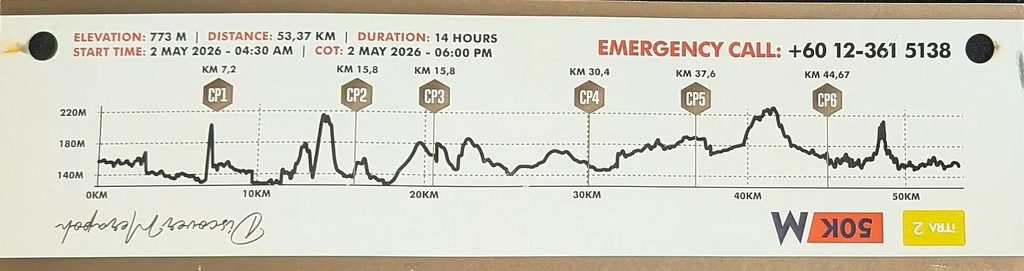
CP3 (21.3km), what I had optimistically labelled in my mind as halfway, was the main CP with the largest food selection and had quite a crowd.
Having learnt how much time is burnt in CPs if you don’t have a plan, I stuck to my guns of refilling water and electrolytes again, grabbed a couple pieces of fruit and peeled out of there.
From there, it was more running through plantations, then up a storm drain for a couple of hundred meters before popping back into the forest and exiting onto a stint next to the main road.
At this point the temperature was starting to rise to the late 20’s despite being ~9a.m. and I realised a finish before noon was well out of the question.
After ~4km the course turned onto small village access roads, 4×4 tracks and forest trail through CP4 for another refill of liquids and electrolytes before reaching CP5.
Overall CP3 (21.3km) to CP5 (37.6km) was a runnable mix of terrain despite the rising temperature and humidity. During this time, the temperature passed north of 30 degrees, was burning when out in the open and relative humidity was still hovering around 90%.
At CP5 (37.6km) I reached Sungai Persit, Persit River, restocked up on water, electrolytes, ice, watermelon and banana bread then started the ~2.5km wade up the Persit river.
Short sections of stony or sandy banks would appear for 5-10m then vanish, sending us back into shin to knee deep water with only one hole that had the river reaching the base of my running vest.
After finishing this first river section, before reentering the forest everyone spent 5-8 minutes removing inner soles and washing the accumulated sand and pebbles from our shoes and socks.
From there, I joined a train of fellow runners and we hiked/jogged across a saddle that formed the highest section of the course although the terrain was gradual enough that you hardly noticed the climb. Barring one short 50m stint immediately after another unavoidably wet river crossing.
Descending the saddle brought us through a hidden valley of long, lush green fields surrounded by the cliffs of limestone karsts, saphire sky and fluffy clouds drifting overhead before entering the shade of another palm oil plantation until reaching Gua Lima.
Gua Lima was the third and final cave of the run, a tunnel tall enough to stand in with a stream winding through the entire ~60m length. This was a thigh deep wade by headtorch before existing onto wet clay and continuing through the palm plantation to CP6 (44.67km)
A quick refill of water, electrolytes in one chest bottle and the welcome mistake of 100Plus in the other, once again a banana and some watermelon and off again for the final stint.
From CP6 to the finish line at 53.37km, we wound through runnable plantation track, another ~1.5km downstream through a river, some forest trail and ended with ~4KM of gravel and tarmac road before turning into the finish line just before 2p.m. while watching Miler competitors heading out to start their final 50km loop.
What Happened?
Heading straight to the finishing makan (eating) area, I filled up on iced milo while contemplating how such a flat and seemingly runnable course took almost 1.5 hrs longer than my previous UTA50 experience.
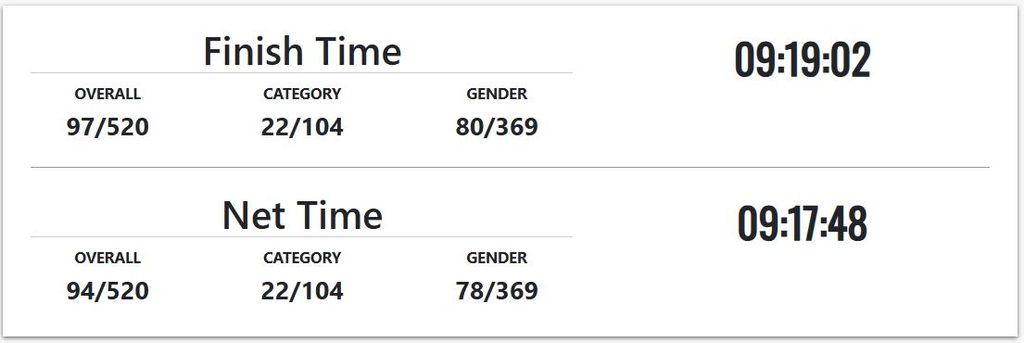
After 16 weeks of base training, my legs and aerobic fitness were fine.
My hydration had been adequate, although I fought off a headache later in the day and my nutrition plan went ok.
- Banana, Pandan bread slice with brown sugar by 15km
- 1st whitebread PB&J by 25km
- 2nd whitebread PB&J by 40km
- Fruit, snack at each CP
- Clif Bloks held in reserve
However what had been missing:
- Time on feet, specifically in the sock and shoe pairing for the run. My feet were too soft and after running wet from the 12km mark onwards were blistered and uncooperative for the final 10km
- Race specific training. I hadn’t done any runs longer than 13-15km. This affected both my feet and mindset
- I was doing the event to complete entry criteria rather than racing for a specific time or personal goal
- Adaptation to the heat and humidity. I realised afterwards that the area was under an extreme heat hazard warning and despite living in Singapore for the last 7 years, I haven’t adapted enough to the humidity. While I’ve done the Kosci100 and am training for the Jeju100 in October, the Merapoh 100km was 100% off the cards that day and my hat off to everyone who completed it
Review
This was a hard day out.
Not for the elevation.
Not for the terrain.
For the heat and humidity.
This was a great day out full of adventure and company through trail, plantations of different ages and care, rivers and caves!
Immediately afterwards, I wasn’t sure whether I would be back given just how draining such a seemingly innocuous course was. Now 2-3 days removed, my blisters all but healed and sitting in air conditioning I can confidently say I’ll be back although definitely not for the Miler.