How much fluid should you drink in an ultra?

Mark Green
The biggest hydration-related concerns when taking part in endurance events are becoming either dehydrated or hyponatraemic.
Hyponatraemia – means you have a low level of sodium (salt) in the blood and it is caused by drinking too much water
Dehydration – occurs when you use or lose more fluid than you take in, and your body doesn’t have enough water and other fluids to carry out its normal functions.
Of these two conditions, Hyponatraemia has the potential to be more medically dangerous. Severe hyponatraemia can lead to coma and can be fatal. Dehydration can have a negative impact on your performance, and severe dehydration can result in becoming hospitalised and needing intravenous fluids to help rehydrate your body.
How do you know how much to drink?
The best way to know how much fluid you need when you run is to do a simple sweat test. As a broad guideline the average sweat rate is around 600ml -750ml per hour, although you need to consider that this varies greatly depending on pace, air temperature, fitness level and you – some people are just sweatier than others.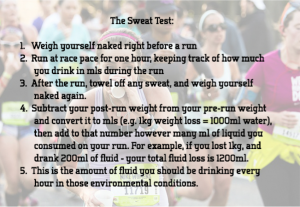 NB: Because this test only determines your sweat losses for the environmental conditions you run in on that day, you should retest on another day when conditions are different to see how your sweat rate is affected. You should also redo the test during different seasons, in different environments (such as higher or lower altitudes), and as you become faster, since pace also affects your sweat rate.
So why is staying hydrated so important during your run?
Water is key in keeping your blood, which contains much needed oxygen and sodium, flowing quickly and easily to your heart, lungs and muscles. It also helps every other part of your body which is needed to run well to function at its peak. When you become dehydrated, your blood becomes thicker, which makes your heart work harder to pump blood to the body parts that need its fuel.
Is it possible to over-hydrate?
Yes, especially for beginner runners. You can actually drink too much water while running which waters down the salt levels in your blood and you can become hyponatraemic.
When you are new to running, you are probably not running at the same intensity as an experienced runner, which means you might not be sweating as much. In other words, slower runners don’t lose liquid from their body as quickly as someone running at a harder effort and pace.
Finding the right fluid balance between dehydration and over-hydration is something you will learn as you continue to consistently run and test what works best for you.
Don’t forget the salt!
When you sweat during running you are also losing salts – mostly sodium. For endurance events it is important to replace these salts as it improves hydration which allows the water to get into the cells, reducing the risk of hyponatremia occuring and also reducing the risk of muscle cramps.
For an endurance event consider taking a salt replacement capsule, these are available from good sports stores – popular brands are Hammer Endurolytes, or Salt Sticks.
Some fuel sources (liquids, gels, chews etc ) have salt added to them – although you need to carefully check the labels, because generally speaking these sources won’t have enough sodium concentration for events longer than 6 hours duration.
This article was written by Tamara Madden from Mad On Nutrition