Eating Gels in a Race (and Why It Still Goes Wrong Sometimes)

Mark Green
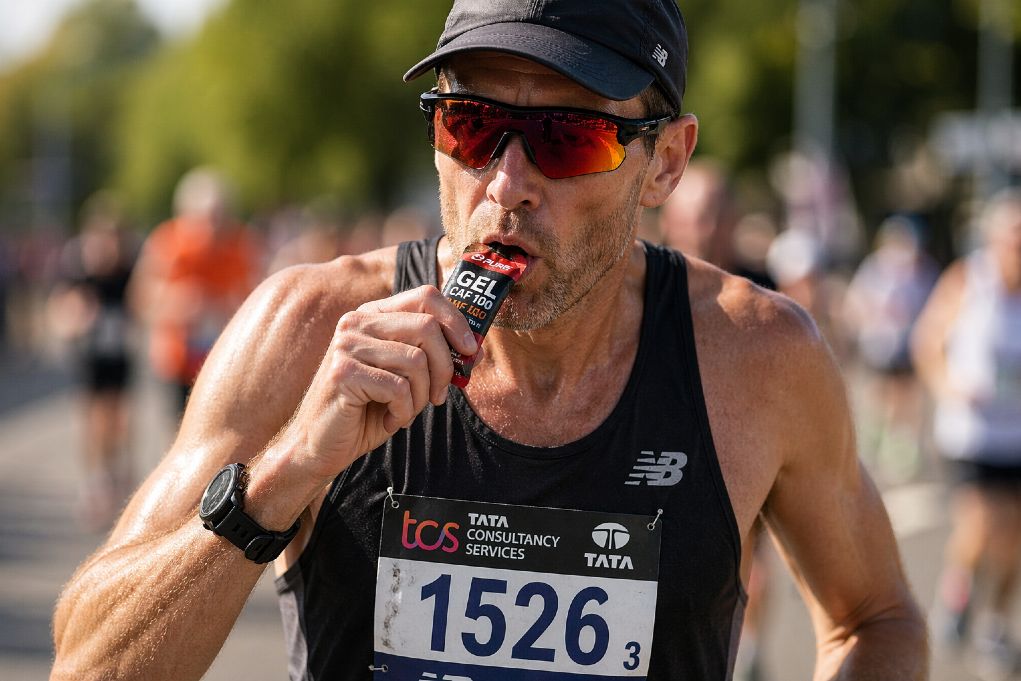
I have been racing half marathons, marathons and ultras for over 40 years, and I still feel like my race nutrition is a work in progress.
Sometimes I get it right and a race goes exceptionally well.
Sometimes I get it wrong and a race goes exceptionally badly.
That hasn’t really changed with experience. The margin for error just gets more obvious.
The simple idea (that isn’t actually simple)
Pretty much all of the current science points in the same direction:
The more carbohydrate you can take in during a race, the better you will perform—and the quicker you will recover.
But there is a catch.
You also need to not vomit.
If you take in more than your gut can handle, things can go downhill quickly. Nausea builds, fuelling stops, and performance drops sharply.
So it’s not just about eating more.
It’s about eating more that you can actually tolerate at race intensity.
Two races, two very different outcomes
A good example of how important this is:
Kosci 100 (2024)
I started too hard. My heart rate was sitting at the top of Zone 4 (~165 bpm) from early in the race.
At that intensity, it became very hard to eat.
I managed around 25–30g of carbs per hour (about one gel), and by 60km I was completely cooked.
My calves and hamstrings were cramping badly. I was reduced to little more than a walk.
Mentally, it also fell apart. The last 40km became a long internal conversation about why I was doing it—and whether I would ever do another ultra again.
Motatapu 50k (2026)
This time I got the pacing right.
My heart rate stayed in Zone 3 (<155 bpm). I started fuelling early and kept it consistent throughout.
I averaged around 100g of carbs per hour for the entire race.
The difference was obvious:
- I ran strongly to the finish
- Cramping was minimal
- And most importantly, my mindset stayed positive
Even though the course was tough, I never had those low points where your brain starts negotiating with you to stop.
What I’ve learned over 40 years
I’ve tried almost everything over the years:
- Fluid carbohydrates
- Meal replacement drinks
- Real food (potatoes, sandwiches, etc.)
- Lollies
- Even macadamia oil during a high-fat phase
- And of course gels
Back in the 1990s, gel options were limited. I did the 60km Kepler Challenge in New Zealand on rum-and-coke flavoured gels, which was enough to put me off gels for almost 20 years.
These days, there are far more options.
Different textures, different sweetness levels, different consistency—from thick jelly-like gels to very fluid ones.
There is pretty much something for everyone now.
A simple marathon gel schedule (example)
If you’re not sure where to start, this is a simple, repeatable structure for a marathon:
Before the start
- 1 gel about 10–15 minutes before the gun
During the race
- 20–25 min → Gel 1
- 45–50 min → Gel 2
- 1:10–1:15 → Gel 3
- 1:35–1:40 → Gel 4
- 2:00–2:05 → Gel 5
Then continue every 20–30 minutes if needed.
This typically gets you into the range of:
- ~60–90g of carbohydrate per hour (depending on the gel)
Just as important:
- Take water regularly at aid stations to help absorption
Most of the time, it’s just this:
- Start eating early
- Keep it consistent
- Don’t fall behind
Finding what actually works for you
One of the most important lessons I’ve learned is that there is no single “best” gel or nutrition strategy.
For example:
At Motatapu, I used gels from Pure Sports Nutrition and they worked really well for me.
At Kosci, I used Maurten and Precision Fuel & Hydration and I personally didn’t tolerate them as well.
That doesn’t mean those products are bad. They work extremely well for many athletes.
It just reinforces the point:
Everyone is different.
The key point
You need to find what works for you.
And that takes time.
It usually involves:
- Trying different products
- Testing at race intensity (not just easy runs)
- Learning how your gut responds under load
Just because gels haven’t worked for you at one stage doesn’t mean you’re out of options.
It might just mean you haven’t found the right combination yet—or haven’t trained your gut to handle it.
Final thought
After 40 years of racing, I don’t think there is a perfect nutrition plan.
But there is a clear pattern.
When I:
- Pace well
- Fuel early
- Stay consistent
Things go well.
When I don’t, they don’t.
And most of the time, the difference comes down to something surprisingly simple:
whether I got my fuelling right in the first hour of the race.